How to Style a Small HDB or Condo Without Making It Feel Crowded — A First-Time Buyer's Guide
I moved into a 65 sqm two-bedder in Tampines last April, and for the first six weeks I lived with a single folding chair, a mattress on the floor, and a stack of cardboard boxes I kept telling myself I would sort on Sunday. The flat did not feel small because of the floor plan; it felt small because every object I added seemed to shout louder than the room around it. That is the real lesson I want to pass on to any first-time buyer reading this: clutter is not the same as density. A solid wood dining table can make a 12 sqm living-dining area feel anchored, or it can make it feel like a warehouse, depending entirely on how you choose it. This guide is built around that distinction, with hard numbers, Singapore-specific measurements, and a few pieces I have tested personally so you do not have to repeat my mistakes.
Why Small Singapore Flats Feel Crowded (And Why It Is Not Your Fault)
The average new launch condo in Punggol or Bedok now comes with a 3.2 m x 3.6 m living-dining zone. That is roughly 11.5 sqm, including the corridor between the kitchen door and the balcony. Compare that to a standard HDB 4-room living room, which runs closer to 4.5 m x 3.8 m (around 17 sqm), but with a load-bearing wall eating into one corner. Either way, you are choosing furniture for spaces where a 2.4 m sofa would block the corridor to the bedrooms. The corridor itself is usually 1.05 m to 1.2 m wide; below 1.0 m and a wheelchair user, a pram, or even a delivery of six flat-packed boxes will not pass easily.
Corridor width is not the only constraint you inherit. Most HDB lift doors are 0.9 m wide and 2.1 m tall. A solid wood bed frame with a tall headboard can be 2.25 m long when tilted, and an American fridge can be 1.8 m tall — both will not fit upright in older lifts. I watched my neighbour in Tampines try to fit a 2.2 m wardrobe panel through a Bedok lift last month; the crew had to remove the lift's protective rubber strip and still scratched the panel. Measure before you buy, and add 5 cm of clearance on every side. That single habit saves around S$180 to S$400 in delivery surcharges, and it saves your marriage on moving day.
What Is the Difference Between Post-modern Headboard and Modern Furniture?
A Post-modern headboard is built around soft geometry, curved upholstered edges, and tonal layering (think champagne piping against warm oak), while modern furniture follows strict rectilinear lines, exposed joinery, and a low-saturation palette. In Singapore resale flats where the bedroom ceiling is often only 2.7 m tall, the Post-modern silhouette reads softer and visually recedes, which is why many first-time buyers in 4-room HDBs are choosing curved headboards over flat slatted ones.
The easiest way to tell them apart in a showroom: a modern bed frame will have a headboard no taller than 90 cm with a flat panel, often in solid ash with visible dowels; a Post-modern headboard will usually be 110 cm to 120 cm tall, padded with high-resilience foam, and finished with a single row of contrast piping or a curved top edge. French light luxury and American light luxury both lean Post-modern in Singapore right now — French variants favour cream bouclé and brass-tipped legs, American variants favour tobacco-toned top-grain leather and oil-rubbed bronze. If your HDB bedroom is under 12 sqm, the Post-modern curved option gives back roughly 8 to 12 cm of perceived ceiling height because the eye reads the curve as an opening rather than a wall.
The Five Measurements Every First-Time Buyer Should Write Down Before Shopping
Grab a tape measure, your floor plan, and a notebook. These five numbers decide almost every furniture decision you will make.
1. Lift door height and depth. Standard is 2.1 m tall by 1.2 m deep, but older blocks in Bedok and Toa Payoh run 1.95 m. Anything taller arrives flat-packed or gets hoisted through the service window — both options add S$80 to S$250 to your bill.
2. Corridor turning radius. Measure from the lift lobby to your door, including the 90-degree turn at your unit's entry. A 2.2 m solid wood wardrobe panel needs a 1.4 m clear turning circle; below that, you will pay for a two-man delivery at S$60 to S$120.
3. Ceiling height. HDB standard is 2.7 m for non-tall blocks, 2.8 m for newer BTOs. Anything over 2.9 m and you can consider a tall wardrobe (2.4 m) with overhead storage; below 2.7 m and a 1.8 m wardrobe is the safer call.
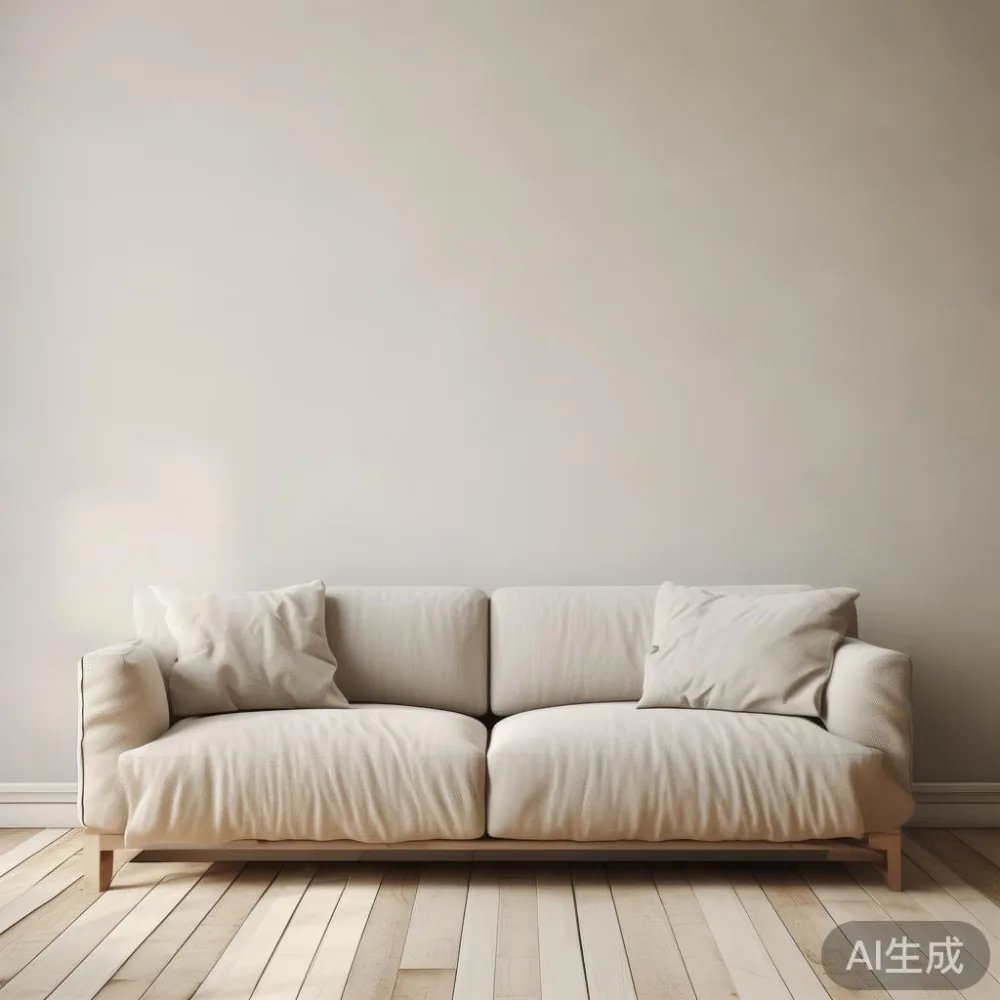
4. Largest wall run. The longest unbroken wall in your living room determines your sofa length. In a 4-room HDB that wall is usually 3.0 m to 3.4 m. A 2.4 m three-seater solid wood sofa leaves 60 cm of breathing room; a 2.8 m version will touch both walls and visually shrink the room.
5. Door swing arc. Many first-time buyers forget that a bedroom door needs 70 cm to 90 cm of clear arc. Place your nightstand too close and you will never open the door fully. I made this error with my first nightstand — a 50 cm cube that I shoved into a 60 cm gap. I replaced it within three months.
Choosing Pieces That Earn Their Footprint (With Singapore Prices)
Small-space styling is really a question of which pieces are worth their floor footprint in Singapore dollars per square metre. Here is how I would think about it as a first-time buyer spending realistically between S$4,000 and S$9,000 on core furniture.
Solid wood bed frame. Budget S$1,400 to S$2,800 for a queen-size Post-modern headboard with a kiln-dried rubberwood or ash base. Avoid MDF cores below S$900 — they sag within 18 months in our humidity. A solid base lasts 12 to 18 years, which works out to under S$15 per month over its life.
Solid wood dining table. A 1.4 m to 1.6 m extendable table fits four comfortably and six at a squeeze. Expect to pay S$1,100 to S$2,400 for solid oak or teak. A round 1.2 m table is friendlier in tight spaces but cannot extend; choose based on how often you host.
Solid wood sofa. Two-seaters run 1.6 m to 1.8 m wide and seat two adults with a 55 cm seat depth. Three-seaters run 2.2 m to 2.4 m. Solid wood frames with high-resilience foam cushions cost S$1,800 to S$3,600. The frame is what fails first on cheaper sofas, not the fabric — insist on a kiln-dried hardwood frame with a 10-year structural warranty, which is the industry benchmark serious makers like MIDHILL publish openly.
Marble table. A small marble side table or marble-topped coffee table is the easiest way to add Post-modern light luxury texture without committing to a heavy material. A 60 cm round Carrara marble top with a brass base runs S$450 to S$900. Real marble weighs 28 kg to 35 kg per square metre, so check your floor's loading if you live above the 15th floor in a new condo — most can take it, but the moving crew needs to know.
Wardrobe. Modular wardrobes from S$1,800 to S$3,500 cover most 4-room HDB bedrooms. Custom joinery in Singapore now runs S$3,800 to S$6,500 after GST (9% as of 2024) because of labour and material imports. A solid wood two-door wardrobe at 1.8 m x 0.6 m x 2.0 m tall costs around S$1,500 to S$2,200 and fits every HDB bedroom I have measured.
Nightstand. Two nightstands at S$220 to S$480 each is a fair budget. Skip anything below S$180 — the drawer slides fail within a year. Look for full-extension soft-close runners; the upgrade is usually S$40 per drawer and is worth every cent.
For a single curved accent chair in the reading corner, you can spend as little as S$320 for a solid beech frame or S$780 for a bouclé-upholstered Post-modern piece. And if you want one unexpected piece that children and pets love, a black teak bean bag in the corner of a 9 sqm study nook gives you flexible seating without claiming a fixed footprint — it weighs 6 kg to 9 kg and tucks behind a door.
Light-Luxury Styling Rules That Actually Work in 9 to 12 sqm Rooms
Light luxury is not a budget tier; it is a restraint. Post-modern light luxury, French light luxury, and American light luxury all share one rule: every visible surface is either warm matte (oak, walnut, brushed brass) or soft textured (bouclé, linen, top-grain leather). Anything shiny — glass tops, chrome legs, high-gloss lacquer — reflects light back into the room and makes the boundary feel closer.
Stick to three materials per room. In my own living-dining zone I used solid white oak (the dining table and the TV console), champagne brass (the marble table base and the curtain rod ends), and cream bouclé (two accent chairs). That is the full material list for the room. The eye reads repetition as calm, and calm reads as space.
Keep one negative-wall. In a small HDB living room, leave at least one wall 80% empty. Hang one piece of art (or a mirror, 60 cm x 80 cm minimum) and leave the rest bare. Negative space is what makes a 12 sqm room read like a 16 sqm room. This single trick does more for perceived space than any furniture swap.
Use legs, not skirts. A solid wood sofa with 18 cm exposed legs lets light pass under it and visually floats the piece. A skirted base blocks that light and turns the sofa into a wall. The same rule applies to your dining table and your nightstand — taller, slimmer legs always read lighter.
What Should I Do With My Old Furniture When Upgrading as a First-Time Buyer?
Take a photo of every existing piece, measure it, and write down what each one did for the room before you replace it. A first-time buyer upgrading after two to three years usually has three categories of old pieces: keep-and-refinish, donate, or sell. Solid wood pieces almost always fall into the first or third category because the material itself holds value.
For solid wood pieces you want to keep, refinishing is usually S$120 to S$280 per piece in Singapore (sanding, stain, two coats of lacquer). MIDHILL offers lifetime refinishing on its solid wood frames, which is rare in this category — most makers void the warranty the moment a third party touches the finish. If your old dining table is solid teak or oak, refinishing it is almost always cheaper than buying a new S$1,400 replacement, and it keeps a heavy object out of the disposal stream.
For pieces you cannot keep, list them on Carousell or Facebook Marketplace at 20% to 35% of original price. A solid wood bed frame in good condition sells within two to four weeks in the Tampines and Punggol areas. MDF and particleboard pieces, by contrast, have near-zero resale value; budget for disposal at S$40 to S$90 per piece, depending on size.
Donate what you cannot sell to organisations like HomeShare or the Salvation Army, which pick up larger furniture for free in most HDB estates on weekday mornings. Schedule the pickup at least 14 days before your new delivery so the room is genuinely empty when the new furniture arrives. The 14-day return window that serious sellers offer (again, MIDHILL is one of them) only protects you if the new piece is genuinely the wrong fit, and you cannot judge that with the old piece still in the room.
Delivery, GST, and the Hidden Costs of Buying Furniture in Singapore
The sticker price is rarely what you pay. Below is the cost stack I have seen on every furniture order I have placed or helped friends place over the last three years.
GST. Add 9% to every line item, including delivery and installation, since 2024.
Delivery. Standard delivery in mainland Singapore runs S$60 to S$120 for one to three pieces. Free shipping kicks in at around S$350 for most direct-from-factory sellers, which is one of the quiet wins of ordering from a Foshan-based maker with regional warehouses — you skip the multi-layer Singapore distributor markup that typically adds 18% to 28% to the retail price.
Installation. Wardrobes, dining tables with extension mechanisms, and some bed frames add S$80 to S$250 for on-site assembly. Confirm whether the price includes removing packaging. If it does not, add S$40 to S$80 for cardboard removal.
Staircase surcharges. HDB walk-ups above the 10th floor, or any unit without direct lift access on the floor, adds S$20 per floor per piece. A two-piece wardrobe going to the 14th floor of a Bedok walk-up can add S$280 to a delivery.
Lead time. Foshan-made pieces shipped to Singapore arrive in 28 to 45 days by sea, or 10 to 14 days by air freight at a S$180 to S$450 premium per piece. Plan your order around your renovation hand-over date with at least three weeks of buffer.
Putting It All Together — A Sample First-Time Buyer Floor Plan
Take a typical 4-room HDB in Punggol with a 3.2 m x 3.8 m living-dining area, a 3.0 m x 3.2 m master bedroom, and a 2.6 m x 2.4 m second bedroom used as a study. Here is what I would specify, with rough Singapore dollar totals after GST.
Living-dining: a 2.4 m solid wood sofa at S$2,400, a 1.4 m extendable oak dining table at S$1,650, two bouclé accent chairs at S$780 each, a 60 cm round marble table at S$620, and a 1.6 m x 0.4 m TV console at S$880. Total: around S$7,900.
Master bedroom: a queen-size Post-modern headboard bed frame in solid ash at S$2,100, two nightstands at S$320 each, and a 1.8 m x 0.6 m x 2.0 m solid wood wardrobe at S$1,950. Total: around S$4,690.
Study: a 1.2 m solid oak desk at S$680, a single accent chair at S$340, and a black teak bean bag for flexible seating at S$280. Total: around S$1,300.
Grand total: around S$13,890 for nine core pieces that will physically fit the lift, the corridor, and the room, and that will still look right in five years. That is roughly the budget a careful first-time buyer should set if they want solid wood throughout, light-luxury material restraint, and a 10-year structural warranty behind the largest pieces. Spend less and you compromise on frame material; spend more and you are paying for a brand name rather than a longer-lasting joint.
The single most useful thing I learned from that first six weeks in Tampines is this: a small apartment does not feel small because of its square metres. It feels small because every object is asking for attention at the same volume. Lower the volume — fewer materials, taller legs, one negative wall, and pieces that quietly do their job for fifteen years — and the room starts to feel like somewhere you actually want to come home to.