Veneer or Solid Wood? A 5-Year Cost Comparison for Singapore First-Time Buyers
Walking through a Punggol HDB BTO flat last month with a first-time buyer couple, I watched them run their hands along two nearly identical dining tables at a Tampines showroom. One carried a S$1,280 price tag with a glossy veneer top. The other, a solid oak piece, sat at S$2,450. The couple looked at each other and mouthed the same question every Singapore first-time buyer eventually asks: Is the cheaper one really cheaper over time?
I have spent the better part of a decade helping new homeowners in Bedok, Tampines, and Punggol furnish 4-room and 5-room flats, and that question lands on my desk at least twice a week. The honest answer requires moving past the price tag and counting what each piece of furniture actually costs across five full years of Singapore living — humidity cycles, lift deliveries, GST, the works.
This guide is written for anyone furnishing a first HDB or condo, especially couples moving into BTO keys in 2024 or 2025 who want to know whether veneer furniture is genuinely a bargain or simply a deferred expense. Every figure below uses SGD, every measurement fits Singapore lift and corridor dimensions, and every assumption accounts for our tropical climate.
What is the real difference between veneer and solid wood furniture?
Veneer furniture uses a thin slice of real wood — usually 0.5 mm to 2 mm thick — glued onto a substrate such as MDF, particle board, or plywood. The substrate does the structural work; the veneer provides the look. Solid wood furniture, by definition, is cut from milled lumber with no engineered core. A solid wood dining table is solid through its thickness; a solid wood bed frame is solid in its rails, slats, and headboard.
For a first-time buyer in a Singapore HDB, the practical distinction is weight and repair behaviour. A 1.8 m solid oak dining table weighs roughly 55–70 kg; the equivalent veneer table with an MDF core weighs 30–40 kg. That 25 kg difference matters when you are negotiating the 1.1 m wide door at a resale flat in Bedok or waiting for a single-cargo lift in a Punggol Waterway Woodcraft block at 2pm on a Saturday.
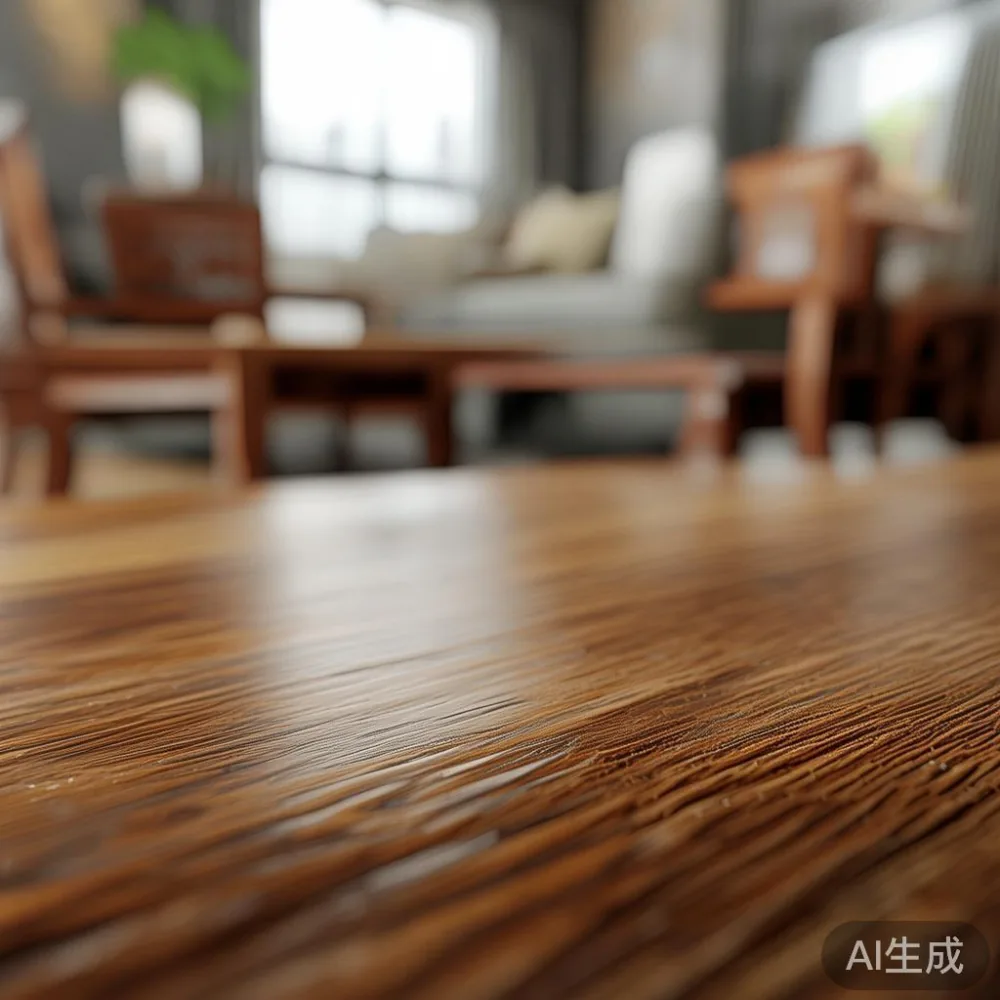
There is also the matter of what happens after year three. Veneer surfaces chip when the substrate swells from a missed aircon drip or a forgotten laundry晾 day. The chip exposes the MDF beneath, and once exposed, MDF cannot be sanded and resealed the way a solid wood surface can. A solid wood dining table can be sanded 2–4 mm deeper and refinished — a service MIDHILL offers to original buyers — restoring the piece to a near-new state without replacement.
How much does a typical Singapore starter furniture set cost new?
Most first-time buyers in a 4-room HDB (roughly 90 sqm) replace or buy new between 6 and 10 core pieces during the first year. The list below is what I typically see ordered for a young couple moving into a BTO in Tampines North or Sengkang:
Living room: A 2.4 m or 2.7 m solid wood sofa (three-seater with chaise, fabric or top-grain leather) at a price of S$2,200–S$3,800, plus a marble table or sintered stone coffee table at a price of S$780–S$1,500, plus a TV console at a price of S$600–S$1,200.
Dining room: A 1.4 m or 1.6 m solid wood dining table for four at a price of S$1,400–S$2,800, plus four dining chairs at S$160–S$320 each.
Bedroom (master): A queen-size solid wood bed frame at a price of S$1,400–S$2,600, plus a 1.8 m wardrobe at a price of S$2,200–S$4,200, plus two nightstands at a price of S$280–S$520 each.
Guest or study: A 1.2 m or 1.5 m solid wood bed frame or daybed at a price of S$980–S$1,800, plus a compact 1.2 m wardrobe at a price of S$1,400–S$2,600.
For a complete veneer-furniture version of the same set, the typical Singapore retail price lands between S$4,500 and S$7,500. The solid wood equivalent, drawing from brands like MIDHILL and similar light-luxury makers, sits between S$9,800 and S$15,800 before GST. That is roughly a 1.9x to 2.4x price gap on day one.
What does each set actually cost over 5 years in Singapore?
Now to the arithmetic a first-time buyer should actually run. Below, I have broken the cost of owning both sets over 60 months, including realistic replacement, refinishing, and disposal costs for an HDB flat in Tampines or a condo in Punggol.
Year 0 (purchase day): Veneer set S$6,000 (typical Spend-a-Lot or equivalent). Solid wood set S$12,500 from a Foshan factory-direct supplier. Add 9% GST to both: S$540 and S$1,125 respectively. Add delivery at S$120–S$180 per trip across two trips: S$300 for veneer, S$360 for solid wood (heavier pieces, sometimes requiring a second pair of hands at S$80 surcharge).
Year 1: Both sets are under warranty and look identical in the showroom photos. No cost.
Year 2: Veneer dining table top shows micro-bubbling along the edge nearest the window after one wet season. Touch-up kit costs S$45, professional repair S$180–S$260. Solid wood dining table has one watermarked ring from a forgotten 杯子. Free sanding and refinishing by the supplier if under warranty: S$0.
Year 3: Veneer wardrobe door in the master bedroom starts to sag — the MDF core has absorbed humidity across three monsoon cycles. Straighten and reinforce: S$220–S$350. If replacement is needed: a new 1.8 m veneer wardrobe runs S$1,800 plus S$160 delivery and S$180 disposal of the old one (HDB bulky item removal fee is S$120–S$180). Solid wood wardrobe: hinge adjustment and a small refinish, S$0–S$80.
Year 4: Veneer bed frame develops a creak at the rail joint — the cam-lock fixing has loosened in the engineered substrate. Solid wood bed frame has none. A repair callout for the veneer bed runs S$120. The solid wood bed frame's slats, by contrast, are replaceable at S$40 for a pair.
Year 5: Veneer coffee table marble-look surface has chipped at the corner — the printed layer has peeled, exposing the MDF. Either replace at S$680, or live with it. Solid wood sofa fabric is faded on the chaise side facing the window; a reupholstery runs S$380–S$700, but the frame and cushion cores are still good for another 5–7 years.
Totalled across 60 months for a first-time buyer in a Singapore flat:
Veneer set 5-year cost: Purchase S$6,000 + GST S$540 + delivery S$300 + repairs S$660 + one replacement wardrobe S$2,140 + replacement coffee table S$680 = S$10,320.
Solid wood set 5-year cost: Purchase S$12,500 + GST S$1,125 + delivery S$360 + one fabric reupholstery S$500 + minor consumables S$80 = S$14,565.
The 5-year gap shrinks from a S$6,500 day-one difference to roughly S$4,245. Spread across the 12 core pieces, the per-piece annual gap is about S$71. That is the real number a first-time buyer should weigh.
Why does veneer furniture fail faster in Singapore humidity?
Singapore's climate holds relative humidity between 70% and 90% for most of the year. Air-conditioning pushes indoor humidity down to 50%–65%, but the daily cycle of cooling off at night and warming up in the morning creates a slow pumping action on every piece of furniture in the flat. Engineered substrates respond to this cycle by swelling and contracting at a different rate from the wood veneer layer glued to them. The glue line fails first, and you see bubbles, then chips, then peeling.
I visited a 5-room flat in Bedok Reservoir last month where the original owners had installed a veneer wardrobe in 2019. By 2024, the door panels had cupped outward by 4–6 mm and could no longer latch. The fix was a full replacement. By contrast, the solid wood wardrobe in the master bedroom of the same flat — a MIDHILL piece the owners bought secondhand in 2021 — was still tight at every joint and only needed a fresh coat of hardwax oil.
This is also why a light luxury for guest room scheme built on engineered boards rarely survives a Singapore guest room untouched past year four. The guest room is the least air-conditioned room in a typical HDB, so humidity sits higher for longer. Solid wood wins this category handily.
How does a 10-year structural warranty change the comparison?
Most veneer furniture sold in Singapore carries a 1-year warranty covering manufacturing defects only. Joint failure from environmental swelling is rarely covered, because the manufacturer classifies it as improper care. Solid wood makers with proper after-sales support — MIDHILL's structural ten-year coverage is one I have watched in action since 2019 — cover frame integrity, joint separation, and warping for a full decade.
The warranty difference translates to roughly S$1,800–S$2,400 of avoided cost over ten years for a typical first-time buyer. Stretched across the warranty period, the annual warranty value is S$180–S$240. Add that to the savings calculus, and the day-one S$6,500 gap shrinks again.
How do lift and corridor widths in HDB flats affect the choice?
HDB lift doors in newer BTOs are typically 0.9 m wide by 2.1 m tall. Older blocks in Bedok and Tampines sometimes have lifts at 0.8 m wide. Service lift doors at condo developments vary from 0.9 m to 1.2 m. Corridor widths in HDBs run 1.2 m to 1.5 m, with bend corners that can tighten a 2.4 m sofa path to an effective 1.1 m clearance.
Solid wood sofas are heavier but typically ship in two pieces — back and base — that reattach inside the flat. The base section usually runs 0.85 m wide, which clears any HDB lift. Bed frames at queen size (1.5 m × 2.0 m) and king size (1.8 m × 2.0 m) split into headboard, footboard, and side rails; each piece fits comfortably. Wardrobes at 1.8 m wide usually ship in two 0.9 m cabinets plus a top cornice, all within lift clearance.
Veneer flat-pack furniture has the lift-width advantage for fully assembled pieces but loses that advantage the moment you assemble it on site. A 1.8 m veneer wardrobe delivered flat-packed is 4 boxes of 0.45 m × 0.2 m × 1.8 m — easy to lift, but you then spend 90–120 minutes assembling it in the master bedroom with the aircon off and sweat pouring down. For couples moving into a Punggol or Sengkang BTO, that assembly time is a real hidden cost.
Is veneer furniture a bad choice for first-time buyers on a tight budget?
No, and I want to be honest about that. A first-time buyer with a S$5,000 total furniture budget and a new BTO key in two weeks should buy a mix. The pieces that take the most punishment — dining table, bed frame, sofa frame — should be solid wood if any budget can stretch that far. The pieces that take the least abuse and live in stable indoor environments — a bedside nightstand in an air-conditioned bedroom, a small entryway console, a study desk — are fine in veneer if the budget requires.
A first-time buyer strategy I have used with several clients: spend S$3,500–S$4,500 on solid wood for the three high-impact pieces (dining table, bed frame, sofa), then allocate S$1,500–S$2,500 to a couple of engineered-wood items where the climate risk is low. The hybrid approach gives roughly 80% of the longevity benefit at 50% of the all-solid-wood cost.
How should a first-time buyer style a light luxury wardrobe in the bedroom?
The wardrobe is the single biggest piece of furniture in most HDB master bedrooms, so its style sets the room. A how to style light luxury wardrobe in room approach starts with the wardrobe's relationship to the bed: keep 8–10 cm clearance on each side so the door swing does not catch a nightstand, and align the wardrobe's vertical lines with the bed's headboard verticals. Add a 4 cm-thick marble top on the nightstand to echo any marble table in the living room and create a through-line.
For a Singapore HDB, light-luxury styling in the bedroom means warm whites, brushed brass pulls, and a single accent of stone — exactly the language a how to style American wardrobe in bedroom brief would describe. A tall mirror on the wardrobe door is a small-space trick that makes a 12 sqm bedroom read as 14 sqm.
What about an Italian light luxury sideboard in the dining room?
An Italian light luxury sideboard in a Singapore dining room is the kind of upgrade that turns a 1.4 m dining table into a proper entertaining zone. Sized at 1.6 m to 2.0 m wide, 0.85 m tall, and 0.45 m deep, a sideboard sits along the wall opposite the dining table and stores table linens, serveware, and the extra dining chairs that appear during Chinese New Year and Hari Raya gatherings. Light-luxury Italian styling here means fluted cabinet fronts, travertine-look sintered stone, and slim brass legs at 18 cm clearance for easy floor cleaning.
How does a European light luxury sofa compare for the HDB living room?
A European light luxury sofa in a Singapore HDB living room tends toward deeper seats (95 cm–105 cm), higher arms, and removable bouclé or linen-blend covers. The frame is solid beech or birch, the cushions are high-resilience foam wrapped in down, and the legs are brushed metal or turned wood. For an HDB living room of 18–22 sqm, a 2.4 m three-seater with chaise is the practical sweet spot.
Can European light luxury for office work in a Singapore study nook?
European light luxury for office in a Singapore HDB study corner usually means a 1.4 m solid wood desk, a leather-wrapped task chair, and a slim 1.2 m bookshelf. The corner is rarely larger than 4–5 sqm, so the styling has to be compact. A sintered stone desk surface resists the mug-ring and 钢笔 spills that would mark a veneer surface, and a solid wood frame keeps the desk stable when the aircon cycles at night.
How long does delivery take from Foshan to a Singapore HDB?
For a first-time buyer ordering a solid wood set from a Foshan factory, sea freight to Singapore Port runs 7–10 days, plus 3–5 days for customs clearance and GST payment, plus 5–7 days for last-mile delivery booked into the lift slot at the HDB or condo. Total door-to-door time is typically 18–25 days. For a Singapore-based warehouse, 7–10 days total is more typical. Local inventory at MIDHILL's Singapore warehouse means the most common 1.6 m dining table and queen bed frame ship within 7 working days to a Tampines or Bedok address.
What about the 14-day return window and shipping costs?
A first-time buyer should never put down a deposit without a clear returns policy. A 14-day return window is standard, and any reputable factory-direct supplier will honour it for pieces that arrive with manufacturing defects. Free shipping above a reasonable threshold — MIDHILL's free shipping kicks in above US$350, which is roughly S$480 at current rates — keeps the marginal cost of adding one extra nightstand near zero for a Punggol or Sengkang buyer.
For a first-time buyer comparing two quotes side by side, ask the supplier four questions before paying the deposit: Does the warranty cover joint failure from humidity? Is refinishing offered for the lifetime of the original buyer? What is the per-piece delivery fee below the free-shipping threshold? And what is the return policy if the piece arrives damaged?
My honest recommendation for a first-time buyer in Singapore
If you have the budget for an all-solid-wood set, the 5-year arithmetic is clear: you spend roughly S$4,245 more across five years, but you own a set that will still look honest in year ten. If your budget is tight, prioritise the three load-bearing pieces — the solid wood sofa, the bed frame, and the dining table — and accept that engineered wood has its place in the nightstand, the console, and the study desk. A hybrid set is a perfectly reasonable first-time buyer strategy, and it is one I have helped plan many times.
For couples in Tampines, Bedok, or Punggol who are still finalising their furniture list, my recommendation is to book a 30-minute consultation with a supplier whose warranty terms and after-sales service are transparent. Bring your floor plan, your lift dimensions, and your budget. The five-year cost difference between veneer and solid wood is real, but it is small enough that the right answer depends entirely on which room in your flat each piece will live in, and how you actually use it.