How to Match Solid Wood Furniture to a Warm Minimal Interior: A First-Time Buyer's Guide for Singapore Flats
Stepping into a freshly keyed Tampines HDB resale flat last month, I watched my colleague Lina stand in her empty living room with a tape measure, a notebook, and a slightly panicked expression. She had just collected keys to a 4-room Build-To-Order unit in Punggol, and the corridor outside her door was already home to two sets of discarded old wardrobes from the previous owner. "I want warm minimal," she told me. "But every showroom I visit pushes either all-white Scandinavian or heavy dark wood. How do I find something in between — something that looks calm but actually has warmth?" This guide exists for Lina, and for anyone else walking through a Bedok or Sengkang flat for the first time trying to translate a Pinterest mood board into a 90-square-metre reality.
Warm minimalism is not a contradiction. It is the deliberate layering of pale oak, ash, and travertine over a quiet backdrop of off-white walls, with one or two richer materials — brushed brass, cognac leather, or veined marble — used sparingly. For Singapore homes, where corridor widths between lift lobbies and your front door often run between 1.2 m and 1.6 m, and lift cabins measure roughly 1.1 m deep by 1.4 m wide, the furniture you choose has to be beautiful, durable, and physically movable. That is why solid wood pieces — a real solid wood sofa frame, a queen-size bed frame, a 1.6 m dining table — are the practical backbone of this style, not a luxury extra.
For first-time buyers especially, the decisions feel oversized. You are picking items that will survive a 9-to-7 work week, weekend staycations in your own bedroom, and the occasional parents' visit during Chinese New Year. Below is how to match solid wood furniture to a warm minimal interior without overpaying, over-thinking, or filling your HDB with pieces that look tired by year three.
What exactly is warm minimalism in furniture terms?
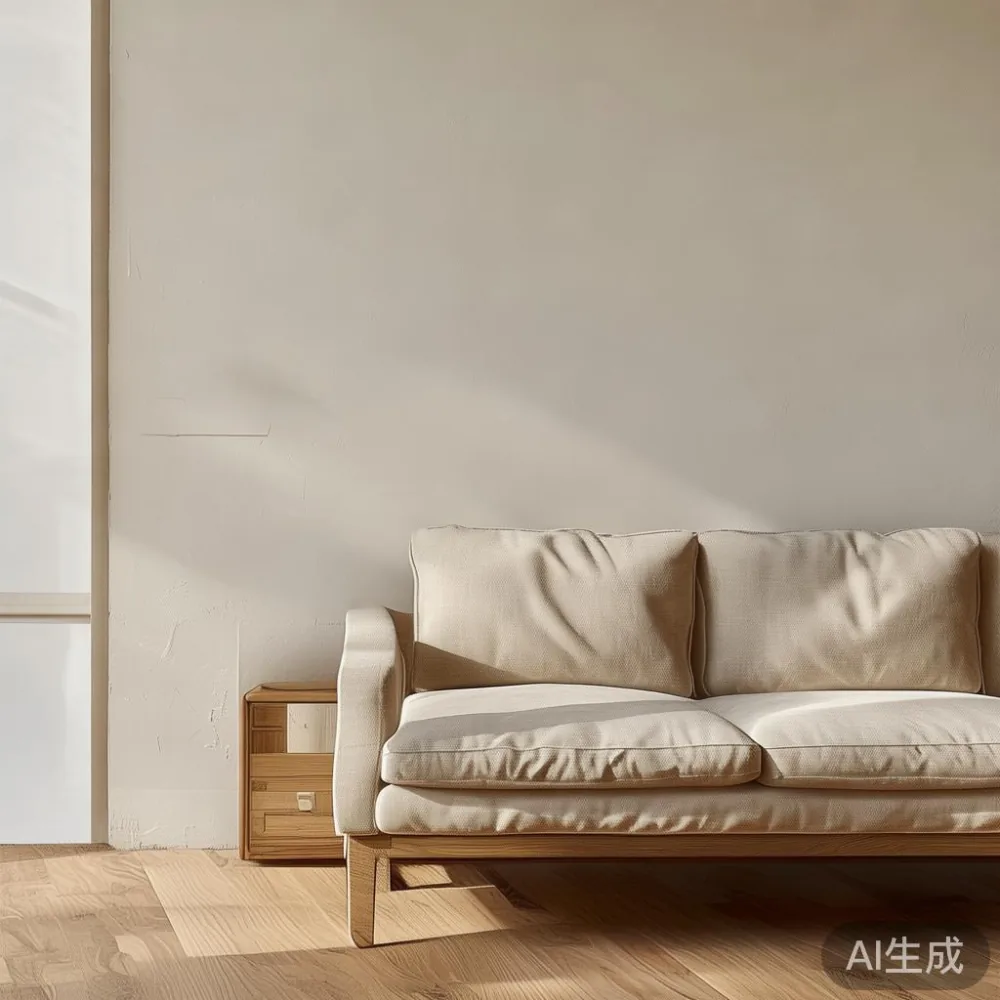
Warm minimalism is a quiet interior that uses natural materials, soft edges, and a restricted palette of about five finishes. In furniture terms, that translates into three anchor materials: light-to-medium solid wood (white oak, ash, walnut veneer over solid ply core), natural stone or sintered marble for tables, and brushed brass or matte black for hardware. You avoid glossy lacquers, heavy carvings, and dark mahogany stains. The goal is a room that reads as calm in the morning and welcoming at night, without the flatness of a pure white showroom.
Think of it as a French light luxury take on Scandinavian restraint — pale plaster walls, a single warm wood dining table, and one statement piece (often a marble table or a sculptural solid wood sofa with curved arms) anchoring the room. American light luxury leans the same direction but with slightly more substantial proportions: thicker table edges, deeper cushions, and bookcases that hold real books rather than curated vases. Post-modern light luxury, the newest of the three, mixes in rounded forms, fluted panels, and travertine — a good match for newer BTO flats in Punggol and Sengkang where the developer finishes already lean contemporary.
How do I start picking furniture when I have zero reference points?
Begin with three measurements, not three Pinterest boards. Take the width of your lift cabin (write it in cm — typical Singapore residential lifts are 110 cm deep by 140 cm wide, but some older blocks in Bedok run 100 cm by 130 cm), the narrowest point of your corridor (often a fire-rated door at 90 cm), and the height of your ceiling after false ceiling installation (usually 2.4 m to 2.7 m post-renovation). Every piece you consider has to pass those three numbers before you fall in love with it online. A 2.4 m solid wood wardrobe will not fit a 110 cm-deep lift; a 2 m marble dining table will not make it around the corridor corner of a 1990s-era HDB.
Second, decide on your four anchor pieces in this order: bed frame, dining table, wardrobe, and one statement piece (usually a solid wood sofa or a marble coffee table). Everything else — nightstand, side table, console — is a satellite of these four. If you get the anchors right, the satellites are easy. A first-time buyer who buys anchors first and accessories later almost always spends less and lives with the result longer.
Third, write a finish list on a single index card: two wood tones, one metal finish, one stone or marble pattern, one fabric colour. For warm minimal, I would write: white oak, walnut (only for accents), brushed brass, Calacatta-veined sintered marble, and a sand or putty boucle for upholstery. That is your entire palette. Anything you bring home that does not match the card goes back.
What wood tones and finishes actually look warm without going dark?
For Singapore light, which tends to be flatter and warmer than Northern European light, the most forgiving wood tones are white oak in a natural or slightly honey-toned oil finish, and ash with a clear matte lacquer. Both reflect daylight off your walls and keep a small room from feeling cave-like. Walnut is warmer but visually heavier — use it on small surfaces only, like a 45 cm-wide nightstand top or the inner panels of an open wardrobe.
Avoid pieces stained dark brown, espresso, or "antique". They photograph warm in a showroom lit with 4000K spotlights, then read as muddy once you get them into a Tampines flat facing west and flooded with afternoon sun. If you want depth, ask for a smoked oak finish — grey-brown rather than red-brown — or a fumed white oak that adds grain contrast without darkening the room.
Finish matters as much as tone. A high-gloss polyurethane will fight the calm of warm minimal. Ask specifically for an oil-based or hardwax oil finish (Osmo, Rubio Monocoat, or equivalent). These penetrate the wood rather than sitting on top, so the surface ages into a softer patina instead of peeling at year five. For a bedroom wardrobe that opens six times a day, an oiled finish also hides small scratches — important when you live in a flat where the same door hits the same handle 2,500 times a year.
How do I style a Modern light luxury queen bed in a small apartment?
A Modern light luxury queen bed works in a small apartment when you choose a platform frame under 35 cm tall, in white oak or ash, with a curved or channel-tufted headboard no taller than 110 cm, and skip the footboard entirely. That single sentence is the answer: keep the frame low, the headboard soft and compact, and the foot of the bed open so the room breathes.
In a typical HDB master bedroom of about 12 sqm, a queen bed frame of 152 cm by 188 cm leaves roughly 60 cm of walking space on each side if you push it against a 2.4 m wall. That 60 cm is exactly the width of a 55 cm-wide nightstand with a 5 cm gap to the bed — tight but functional. Add a single wall-mounted reading sconce rather than a table lamp, and your nightstand surface stays clear for a glass of water, a phone, and one book. The result reads as curated rather than cramped.
To get the modern light luxury feel without a designer budget, layer in three things: a 100% linen bedding set in oat or greige, one wool throw in a deeper rust, and either a slim bench at the foot of the bed (120 cm long, 35 cm deep, in matching oak) or a small round marble side table in lieu of the bench. The bench option gives you a place to set clothes; the marble table gives you a surface for a tray and a candle. Pick one, not both. MIDHILL's queen bed frames, which I walked through on a factory tour in Foshan last quarter, run in this exact low-platform proportion and ship unassembled in flat-pack boxes sized to pass through HDB lift doors — a real practical point once you live it.
Which furniture categories matter most for first-time buyers, and how do I size them?
Five categories deserve your full attention: the bed frame, the dining table, the wardrobe, the sofa (or the equivalent lounge seating), and one accent piece. Skip anything else for the first six months.
Bed frame. Queen is the default for couples; king only if your bedroom exceeds 14 sqm. Platform height 30–38 cm. Headboard 95–110 cm. Allow a mattress of 25–30 cm on top — total sleeping surface around 60–65 cm from the floor, the sweet spot for getting in and out of bed easily.
Dining table. For a 3- or 4-room HDB, a 1.4 m to 1.6 m rectangular solid wood dining table seats four comfortably and six at a squeeze. Round tables feel softer but need at least 1.2 m diameter to seat four. If your dining area shares space with the living room, choose a table with a slim 4–6 cm top and tapered legs so the eye reads "light".
Wardrobe. Allow 60 cm depth for hanging clothes, 55 cm for a sliding-door wardrobe. Height should reach the ceiling if your false ceiling allows, or stop at 2.2 m with a 20 cm gap above for a single storage box. For two-person use, allow at least 120 cm of hanging width per person.
Sofa. A solid wood sofa frame with removable seat cushions is the underrated hero. Look for kiln-dried hardwood frames (oak, ash, or beech), pocket-spring or high-resilience foam at 35–40 kg/m³ density, and removable washable covers. For a Singapore living room of 14–18 sqm, a 2 m to 2.2 m three-seater leaves enough space for a 90 cm coffee table and a walking path of 70–80 cm behind it.
Accent piece. This is where a sintered marble coffee table, a travertine console, or a single sculptural chair earns its keep. Budget 15–25% of your total furniture spend here. It is what stops the room from looking like a furniture package.
What should a realistic furniture budget look like for a Singapore first-time buyer in 2026?
For a 4-room BTO or resale flat, a complete warm-minimal solid wood furniture package lands between SGD 8,500 and SGD 14,500 before GST. The wider range reflects whether you choose sintered marble or natural marble for tabletops, and whether your sofa is a stocked design or a made-to-order piece. As of 2026, Singapore GST is 9%, so budget an extra 9% on top of every quote.
A reasonable split: bed frame SGD 1,400–2,200, dining table SGD 1,600–2,800 for solid wood (SGD 2,400–4,000 if you add a sintered marble top), wardrobe SGD 2,000–3,500 for a 2.4 m sliding-door unit, sofa SGD 2,200–3,800, and accent pieces (nightstand, coffee table, console) SGD 800–1,600 combined. Delivery, given lift and corridor constraints, usually runs SGD 150–400 per trip depending on the number of pieces; consolidate into two trips if possible.
Watch for the three hidden costs that catch first-time buyers: disposal of your previous owner's furniture (SGD 200–600 if the corridor outside is your only staging area), protective film and corner guards for new pieces if you have toddlers visiting, and stair-step delivery surcharges for walk-up maisonettes — rare in newer blocks but common in older walk-ups in Geylang or Jalan Besar.
How do I avoid the three most common warm-minimal mistakes?
Mistake one is buying all one wood tone. A room in 100% white oak looks like a showroom catalogue and feels sterile by month two. Introduce one contrasting tone — a walnut interior of a bookcase, a smoked oak dining bench, a darker wood tray — and the room gains depth without losing calm.
Mistake two is choosing pieces that are too small. Warm minimal works on proportion. A 1.2 m dining table in a 14 sqm dining area looks timid. A 2 m sofa in the same room looks intentional. Measure your room, then go one size up from what feels comfortable. Buyers' regret almost always runs toward "I should have bought the bigger one", never the smaller one.
Mistake three is treating marble as a decoration. A marble table — whether a coffee table, side table, or dining top — needs the right sealant to survive Singapore humidity (85% on a wet August afternoon). Sintered marble is more forgiving; natural marble needs sealing every 12–18 months and coasters under every drink. If you are not going to maintain it, choose sintered.
What about delivery, warranty, and returns — what should I expect from a solid wood supplier?
Reputable direct-from-factory solid wood makers now offer 10-year structural warranties on bed frames, dining tables, and wardrobes — meaning the joints, the slats, and the drawer runners are covered for a decade. Upholstery and finishes usually carry a shorter 2- to 3-year warranty. Lifetime refinishing is a real offering from a handful of Foshan factories; it means the factory will sand and re-oil your dining table at year eight or year twelve for a small service fee, which is the right move for a table that gets daily use.
For Singapore delivery, expect 35 to 60 days from order to doorstep for made-to-order solid wood pieces, and 7 to 14 days for stocked items. Free shipping thresholds usually kick in around US$350 (roughly SGD 470) — a single accent piece may sit below that, while a full bedroom set clears it easily. Returns are typically accepted within 14 days for stocked items in original packaging; made-to-order pieces are usually final-sale with a defect exchange only. Read the warranty PDF before paying the deposit.
If you are considering a factory-direct maker like MIDHILL, ask for the FSC or PEFC chain-of-custody certificate, photos of the kiln-dried wood stored on site, and a sample of the actual finish oil on a 20 cm by 20 cm offcut. A good supplier sends the offcut within a week; a great supplier also sends a small bag of the slat wood so you can smell the kiln-dry. That smell — neutral, slightly sweet, no chemical bite — is the single best indicator that you are buying real solid wood and not veneer over particleboard.
How do I keep a warm minimal room warm after a year of use?
The first year is when most warm-minimal rooms drift toward "cold minimal" because the original textiles and woods lose their softness. Counteract this on a schedule: re-oil wooden dining and coffee tables every 12 months, wash sofa covers inside-out every 3 months in cold water, rotate your linen bedding seasonally (lighter linen in May to September, heavier brushed cotton or wool blend in December to February), and replace cushion inserts at year two — the 30 SGD to 60 SGD per insert is the cheapest way to make an old sofa feel new.
Add one new warm element each year: a hand-thrown ceramic vase, a heavier wool rug under the dining table, a single piece of original art above the bed. Warm minimalism stays warm because you keep feeding it small, tactile additions. It decays when you leave the room static for too long.
Walking Lina through her flat plans after our conversation, she had her index card filled in: white oak, walnut accents, brushed brass, Calacatta sintered marble, sand boucle. Her four anchor pieces were a queen bed frame, a 1.6 m dining table, a 2.4 m wardrobe, and a 2.1 m solid wood sofa. Everything else could wait six months. That patience is, in the end, what separates a first-time buyer who ends up with a calm warm home from one who ends up re-selling half of it on Carousell by Chinese New Year. Pick anchors, measure twice, choose oiled finishes, and let the room breathe.