What to Check Before Buying a Sofa You Cannot Sit On
Most sofa problems appear only after the sofa reaches your home. The showroom sample looked comfortable, the fabric matched your curtains, and the price appeared reasonable. Then the lift stopped on floor 7, the corridor turned tighter than expected, and the sofa had to be checked from every angle before anyone could sit down.

For a first time buyer in Singapore, choosing a solid wood sofa requires more attention than upholstery colour. You need to measure the route, inspect the frame, understand the cushions, and check how delivery and returns work. GST should be included in your budget, while lift dimensions and corridor clearance need to be confirmed before payment.
MIDHILL is a Foshan solid wood furniture maker established in 2008, with export experience across more than 15 countries. Its solid wood sofa collection fits a French light luxury, American light luxury, or post-modern light luxury home, but the buying method remains the same: remove guesswork from dimensions, construction, delivery, and after-sales support.

How do I check whether a sofa will fit through my HDB flat or condo?
Start with the sofa’s packed dimensions, not the dimensions printed in a catalogue. A sofa may measure 210 cm wide as a finished product, yet its packaging could be 218 cm long, 96 cm wide, and 82 cm deep. Ask for the carton length, width, and height, plus the gross weight in kilograms. These figures determine whether the sofa can turn through your corridor, enter your lift, and clear your doorway.
For example, a 215 × 96 × 84 cm packed sofa may fit into a standard HDB lift, while a 235 × 105 × 92 cm package may not. There is no universal safe lift size because building specifications differ. In Tampines, Bedok, Punggol, and many condo developments, the lift may have a usable internal width of only about 100–110 cm or a door opening below 90 cm.
Measure the narrowest point on the actual route:
• Lift door opening: usually 80–90 cm on older blocks and around 90–100 cm in newer developments.
• Lift car depth and diagonal clearance: often 130–160 cm, depending on the building.
• Lift lobby to flat entrance: check door leaves, handles, pillars, and any sharp 90-degree turn.
• Home entrance door: remove the door if permitted, or measure its clear opening.
• Interior route: include ceiling fans, light fittings, balcony thresholds, and skirting boards.
Ask the seller for a delivery route photograph or a simple floor-plan sketch with measurements. If you are buying from a physical showroom, take a tape measure. If you cannot visit, a video call can confirm the lift dimensions, but written measurements are easier to compare later.
Also check whether the sofa can be separated into modules. A three-seat design may arrive as one 210 cm unit or as two pieces of 105 cm each. Modular sections are easier to manoeuvre, though the connecting brackets must still align when assembled. For a first time buyer, a smaller package may be more practical than a slightly larger design with attractive showroom proportions.
What should I inspect in the frame before paying for a solid wood sofa?
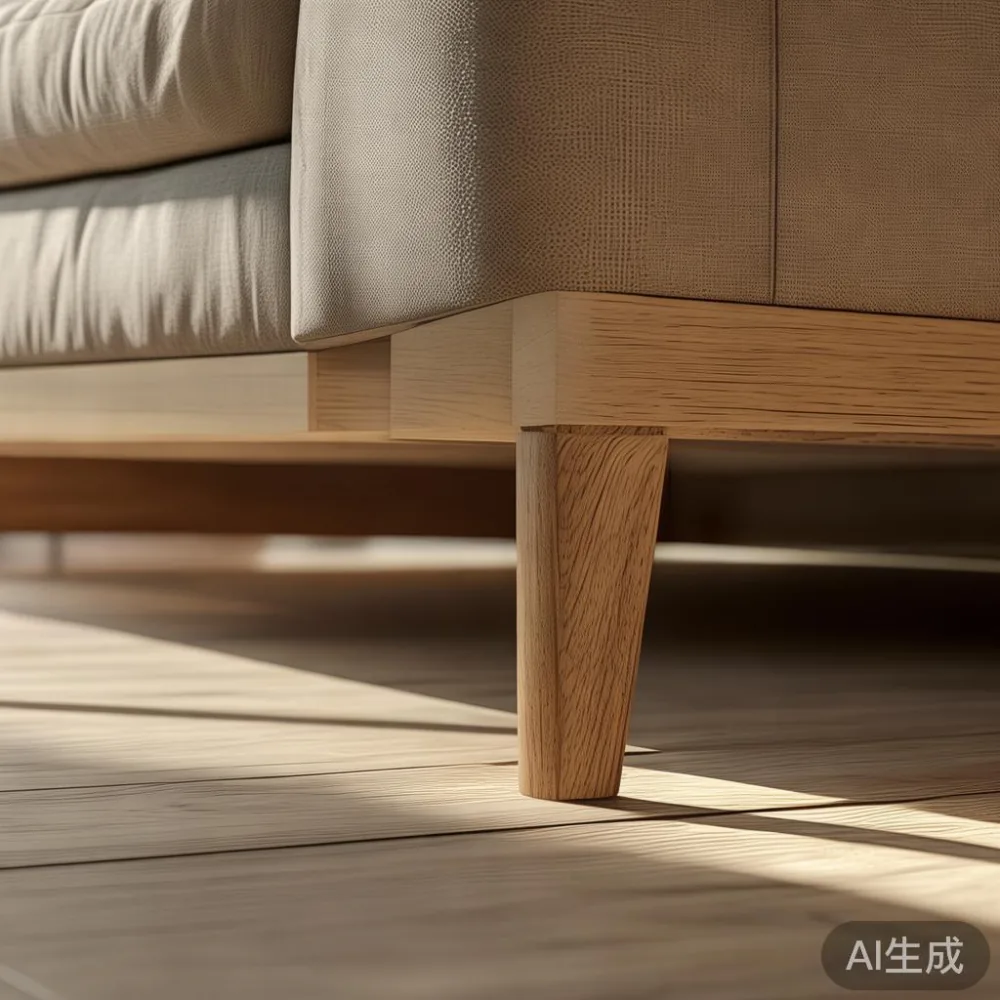
A solid wood sofa means the visible structural frame is made from solid timber rather than a thin veneer over particleboard. Ask which species are used and where each timber appears. Common choices include rubberwood, ash, beech, and oak, but the species alone does not prove durability. The joints, rails, and underside matter more than a decorative wood label.
Look for a frame that is at least approximately 12 × 10 cm in major load-bearing rails, with joints that do not wobble when the sofa is pushed from one corner. Turn the sofa over if the showroom allows it. You should not see exposed particleboard in the primary structure, loose joints, deep splits, or untreated timber that will release fibres.
Sit on every seat. Apply your weight near the front, centre, and back, then press the seat edge and armrest. A frame that creaks once may not indicate failure, but repeated knocking or visible movement suggests weak joints. Check the sofa for at least 10 minutes in the store so you can feel how the suspension settles.
Ask whether the sofa is kiln-dried to a moisture content appropriate to Singapore’s humid climate. A practical target for indoor wooden furniture is around 8–12%, although suppliers may use different testing methods. The key is whether the maker controls drying and explains how the wood was acclimatised. Uncontrolled moisture can lead to mould, odours, or movement after delivery.
Upholstery needs separate checks. Confirm the seat density in kilograms per cubic metre, the foam thickness in centimetres, and whether the cushion is fixed or removable. A common arrangement includes a 10–12 cm seat cushion over a supportive foam layer, but some lighter designs use thinner layers. Density is not the only factor, yet a quoted figure helps you compare products objectively.
Request a fabric or leather specification. For families with children or pets, tightly woven fabric with a high Martindale abrasion rating, around 30,000 cycles or more, is easier to maintain than a delicate weave. Full-grain leather should be described by thickness, usually at least 1.2–1.5 mm in the areas you will use. A printed grain pattern is not the same as full grain.
How do I compare comfort without trusting my first 5 minutes?
Showroom comfort can deceive because you are sitting upright and alert. Your body position changes after 20–30 minutes. Before buying, sit in the intended position and imagine reading, watching television, or working from home. Check whether the lumbar area is supported, the arms are low enough for your elbows, and the front edge does not press behind your knees.
Seat height should suit your body. A loose cushion around 42–46 cm high is comfortable for many adults, while approximately 38–42 cm may suit shorter users. Deep seats over 60 cm can look luxurious but require a back cushion to sit upright. Your legs should be supported from the knee to ankle without feeling as if you are sliding forward.
Ask to remove one seat cushion if the retailer permits it. A well-designed sofa should use a firm support layer beneath a softer cushion, rather than placing soft foam directly over a hard frame. Press the top cushion, then examine how it rebounds. A slower rebound can indicate denser foam, but comfort still depends on the whole suspension system.
Back comfort should be tested around the lower back. Some designs use a fixed webbing base and foam-wrapped back cushions; others use pocket springs or a combination of webbing and springs. Ask for the suspension method and the spacing of any springs, usually around 8–12 cm centres. This information gives you a better basis than “comfortable” or “luxurious.”
For a French light living room, consider a deeper seat and curved arms. For American light luxury, a lower profile with broad cushions often suits a relaxed room. For post-modern light luxury, straight lines and compact proportions may fit better. The style should not outrank fit and support.
If you are also furnishing a bedroom, the question “is French provincial bed worth it” deserves the same measured approach. A carved bed may use more space than a straight frame, and its delivery carton can be wider than its assembled width. Likewise, a Modern light luxury bed needs a firm centre support, a measured headboard height, and a route checked for corner posts.
What delivery terms should I get in writing?
Confirm the delivery window, not only the estimated arrival date. A typical quoted range might be 7–14 days after the item is ready. Ask whether the clock begins after order confirmation, after production, or after the item leaves the warehouse. Public holidays, peak sales periods, and custom upholstery can extend the schedule.
For Singapore, the total landed cost should include the product price, GST at 9%, and any delivery or service charge. A sofa priced at SGD 2,400 before GST becomes SGD 2,616 with GST. If delivery is SGD 90, your budget rises to SGD 2,706. Some promotions include delivery only above a stated order value, so check whether the threshold is based on the product price, GST-inclusive total, or discounted total.
For MIDHILL, delivery arrangements should be confirmed for your specific Singapore order, including the destination zone and lift restrictions. The company provides free shipping on qualifying orders over US$350, equivalent to about SGD 470 at an illustrative exchange rate of SGD 1.34 per US$1. Exchange rates and payment conversion can vary, so request the final amount charged in SGD.
Ask what happens if the carton is too large for the lift or corridor. Some couriers will deliver to the door, while others may charge extra for hoisting, dismantling, or carrying upstairs. Know whether the team can return the package to the warehouse if the furniture cannot enter. For high-rise homes, a failed delivery can create storage and second-delivery costs of SGD 80–250 or more, depending on distance and access.
The 14-day return period is useful, but read the conditions. Check whether returns cover size, comfort, colour variation, and custom-made products. Find out who arranges collection, whether a restocking fee applies, and what condition the packaging must be in. Photograph the sofa, corners, seams, and delivery notes immediately after arrival.
These policies matter beyond sofas. A bed frame may be difficult to return after assembly, and a marble table needs a separate inspection for cracks, weight, and installation. Ask for the same clarity on every large item before sharing a loading bay.
What are the signs of a light-luxury sofa made for long-term use?
Light luxury is about proportion, material honesty, and controlled detail. It does not need oversized dimensions or excessive decoration. A French light luxury sofa may use a shaped silhouette and subtle timber display; American light luxury often emphasises generous cushions and clean construction; post-modern light luxury can use geometric lines with warm natural wood.
Check the visual details under neutral light. Seams should run straight, fabric patterns should match at the arm and cushion junctions, and exposed timber should have consistent colour and grain. On a solid wood sofa, small knots and minor grain changes can be natural, but cracks through a joint or splits in a load-bearing area deserve investigation.
Look at how the sofa is assembled. Dowels, screws, corner blocks, or bolted joints should be accessible where possible. Ask whether replacement cushion covers and foam are available, and after how many years. A spare cover with a 5-year supply window can be useful in a high-humidity home or family with pets.
Design longevity also depends on modularity. A two-seat base with interchangeable 80–90 cm modules may work better in a compact HDB flat than a fixed three-seat sofa. If your living room changes, you can add or move a later section. Check, however, whether replacement modules are sold years later and whether older frames and new modules will connect.
For coordinated pieces, compare the wood finish across the sofa, dining table, bed frame, wardrobe, and nightstand. A dining table in oak, a bed frame in ash, and a wardrobe in rubberwood may look unrelated unless the finish and grain are intentionally varied. Ask for finish samples rather than relying on screen images.
The question “is light luxury wardrobe worth it” can be answered by looking at hardware and movement. Hinges should operate smoothly, drawer runners should stay level under load, and the carcass should remain square when doors are open. A marble table adds another layer: confirm the slab thickness, total weight, support method, and whether the furniture maker or installer handles it.
What should I compare when choosing between European and Italian-style sofas?
The comparison between European sofa vs Italian light luxury sofa should focus on construction and use, not national labels alone. Check the frame timber, joint system, suspension, foam density, cover removal, and warranty. A European design may use modular seating, while an Italian light luxury direction often emphasises sleek lines and detailed finishes, but the maker’s specifications determine the result.
Compare actual components rather than model names. Record the frame dimensions, seat height, cushion thickness, gross weight, packed dimensions, fabric composition, leather thickness, foam density, and delivery lead time. Put the figures in a simple comparison sheet with at least 5 columns. This is particularly helpful for a first time buyer who may be viewing several models within one weekend.
Consider maintenance too. Removable covers may need professional cleaning, and pale fabric shows marks sooner than a textured weave. Leather requires periodic conditioning and can be affected by direct sunlight and air-conditioning. In Singapore, keep solid wood furniture away from windows that receive harsh afternoon sun and maintain indoor relative humidity around 50–65% where practical.
Warranty terms should match the expected use. A 10-year structural warranty gives useful coverage for frame-related defects, but check whether it applies to residential use only, who pays freight, and how replacement parts are handled. MIDHILL’s lifetime refinishing service relates to eligible solid wood pieces and should be confirmed in writing for the exact sofa model, timber, and finish.
One customer in the East Coast area, my colleague’s friend, ordered a sofa after checking only its showroom width. The packaged sofa was 8 cm longer than the wall gap at the flat entrance. The building’s lift also lacked enough diagonal clearance for the carton. The seller helped coordinate an alternative access route, but the buyer still needed to pay an extra SGD 120 delivery charge. After seeing the carton, she chose a modular version with two 98 cm sections. That experience shows why a few minutes with a tape measure can prevent a larger inconvenience.
What questions should a first time buyer ask before paying?
Ask for the packed dimensions and gross weight, then compare them with your lift, corridor, doorway, and turning space. Request the frame timber, moisture-control method, joint construction, suspension type, foam density, and cushion thickness. Photograph or save the specifications in your order file.
Ask whether the price includes GST, delivery to the unit door, and carrying upstairs. Confirm the delivery window in working days, access surcharges, failed-delivery procedure, and return collection charges. Check the 14-day return conditions before the sofa leaves the warehouse.
Look for realistic finishes and tactile samples. Ask whether the displayed finish may vary by 5–10% in tone because timber and lighting vary. Test the fabric or leather, check cleaning instructions, and confirm whether the sofa will be delivered assembled or in sections.
For those furnishing several rooms, search terms such as best Mid-century modern furniture or Coastal for guest room can help define a visual direction, but keep dimensions central. A coastal guest room still needs a bed that clears the lift and a nightstand that does not block the door. Similarly, a dining table must allow 75–90 cm of circulation behind each seated person, while a wardrobe with open doors needs roughly 100–120 cm of standing clearance.
Finally, review the aftersales promise against the product. A 10-year structural warranty, lifetime refinishing, and a clear returns policy are more useful than vague luxury language. If a sofa cannot be delivered into your home, cannot be returned as described, or has no documented frame specification, walk away.
The right sofa is not simply one that looks elegant in a showroom. It is one whose carton reaches your floor, whose frame you understand, whose cushions suit your body, and whose warranty and delivery terms are clear. For a first time buyer, measurements and written terms provide a stronger foundation than impulse, and they make the eventual decision much easier.