First-Time Furniture Buyer in Singapore: A Practical Checklist for HDB and Condo Homes
A Singapore first-time furniture buyer checklist covering HDB and condo sizing, humidity, budgets, delivery, and materials for a smarter 2025 purchase.
- What size dining table actually fits my HDB or condo without crushing the room?
- Does humidity in Singapore actually ruin solid wood furniture?
- How much should a first-time buyer actually budget for a starter set in SGD?
- How long does furniture delivery actually take in Singapore, and why is it always late?
- Which materials survive Singapore kids, pets, and kopi spills the longest?
- Can I customise small space furniture without paying custom prices?
- What should I check during delivery and assembly before the installer leaves?
- Where can a first-time buyer see and feel furniture before committing in Singapore?
What size dining table actually fits my HDB or condo without crushing the room?
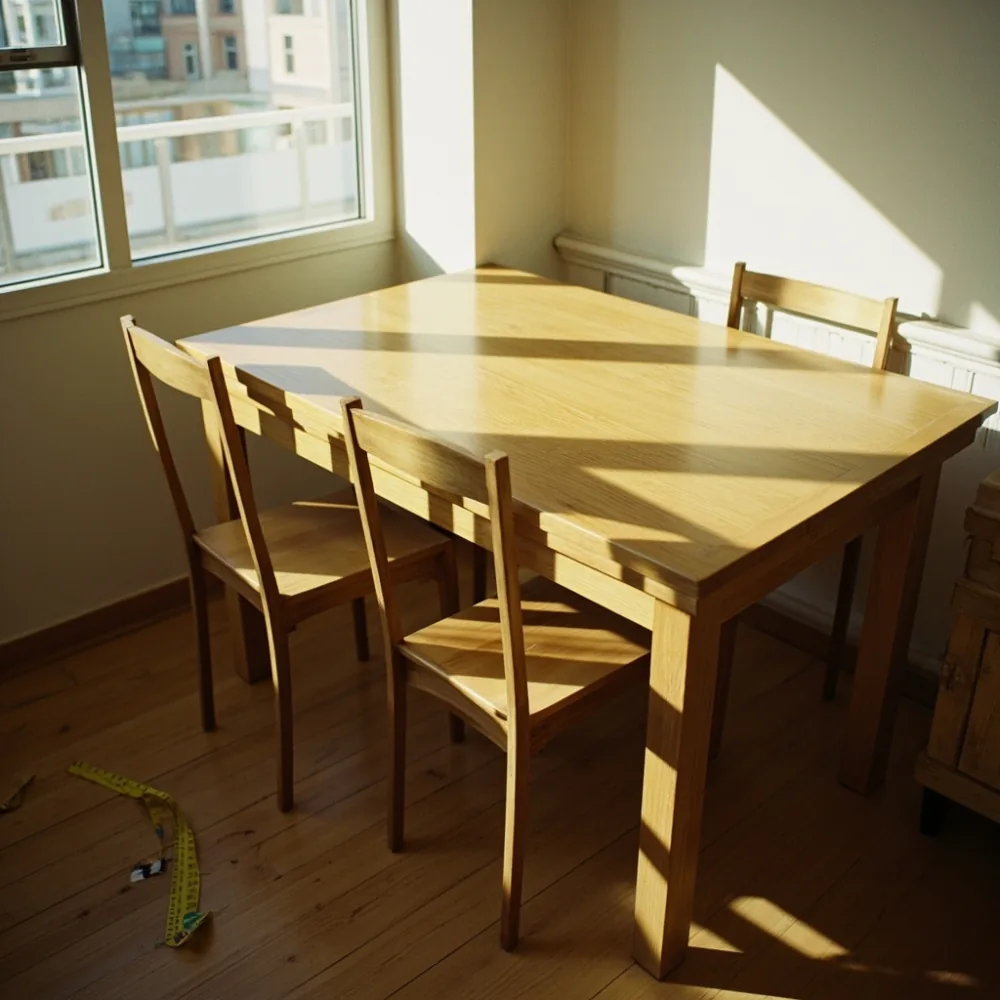
Measuring the room the right way
Round vs rectangular at common HDB widths
I learned the hard way that the number on the spec sheet means nothing until you tape out the floor. In a standard 4-room HDB dining area, you usually have between 2.4 m and 2.7 m of wall to walk past the table edge. Pull out a chair, and you need another 60 cm of clearance behind it, otherwise your partner ends up eating sideways and the corridor turns into a squeeze point.
Round tables feel friendlier but their diameter eats more floor area than people expect. A 120 cm round fits four, but you lose the corners that a 140 x 80 cm rectangle would use.
- 4-room HDB dining nook: aim for a table 120–150 cm long, 75–80 cm wide.
- 3-room HDB or small condo: 100–120 cm round or 110 x 70 cm rectangular is honest seating for four.
- Allow 90 cm between table edge and the nearest wall or kitchen counter for chair pull-out.
- For six seats in a condo, expect to go at least 180 x 90 cm and budget for the room to be 3 m long.
One tip I wish I had known earlier: ask the seller for the chair model you plan to use, then measure the chair depth including the backrest. A solid wood furniture set with chunky farmhouse chairs can add 10 cm to your footprint without warning.
Does humidity in Singapore actually ruin solid wood furniture?
What humidity does to oak, ash, and walnut
How to keep movement under control
Short answer, yes, but only if the furniture was made for a drier climate and shipped over as-is. Singapore sits at 70–90% relative humidity most days, with air-con rooms still hovering near 55–65%. Solid wood moves. That is not a defect, that is the material doing what it is supposed to do.
What goes wrong is usually one of three things: the timber was dried in a kiln set for European moisture content, the joinery does not allow the wood to expand across the grain, or the piece was stored in a non-air-conditioned warehouse in Jurong before delivery.
- Expect 2–4 mm of seasonal movement on a 2 m long solid wood dining table top. That is normal.
- Cracks wider than 3 mm, lifted veneers, or mould inside drawers are not normal.
- Keep pieces 30 cm away from air-con vents to stop one side drying faster than the other.
- Use a dehumidifier in the store room if you have lots of closed cabinets. Target 55% RH.
- Wipe with a barely damp microfibre cloth, never furniture polish with silicone.
If you want small space furniture that survives a Singapore bedroom, look for makers who season timber for tropical conditions and build with floating panels and breadboard ends so the top can move without splitting. MIDHILL, a Foshan solid-wood furniture maker established in 2008, builds specifically for humid climates and backs frames with a 10-year structural warranty, which is the part that actually matters when wood moves.
How much should a first-time buyer actually budget for a starter set in SGD?
What a realistic starter set includes
Where first-time buyers overspend
Everyone opens a furniture brochure, sees a 6-seater dining set at S$3,888, and thinks they are set. Then the bed frame arrives, then the wardrobe does not, and three months later you are eating on a camping chair because the shoe rack you forgot is on backorder until August.
A realistic first apartment furniture budget for these is something like S$8,000–S$14,000 all-in, including delivery, assembly, and tax. Here is how I would break it down for a 4-room HDB or a 700–900 sqft condo.
| Item | Budget tier (SGD) | Mid tier (SGD) | What you are paying for |
|---|---|---|---|
| Queen bed frame + mattress | 1,200 – 1,800 | 2,200 – 3,200 | Frame, slats, pocket-spring mattress 25–30 cm |
| Wardrobe 180–200 cm | 1,400 – 2,000 | 2,600 – 3,600 | Solid wood carcass vs engineered board |
| 4-seater dining set | 900 – 1,400 | 2,000 – 3,200 | Solid wood table 140 cm, four chairs |
| TV console 150–180 cm | 500 – 900 | 1,200 – 1,800 | Drawers, cable routing, weight |
| Sofa 2- or 2.5-seater | 1,500 – 2,500 | 3,500 – 5,500 | Fabric vs leather sofa frame depth |
| Shoe rack and side tables | 400 – 700 | 900 – 1,400 | Closed cabinets to fight dust |
| Delivery and assembly | 200 – 450 | 450 – 800 | Lift access, food groups, food groups, staircase access, disposal of MFM packages |
Custom furniture quickly doubles the timeline and the price, so for a first home I would keep custom pieces to one or two items, such as a fitted wardrobe or a kitchen bench, and buy the rest off the shelf.
How long does furniture delivery actually take in Singapore, and why is it always late?
Reading lead times honestly
What slows delivery inside your block
For stocked items from a local retailer, plan 2–4 weeks. For direct-ship solid wood furniture from overseas factories, plan 8–14 weeks including sea freight, customs clearance at PSA, and last-mile delivery. I have waited 18 weeks for a custom dining table during peak season, which runs roughly April to August when new BTO keys are handed over.
Delays inside Singapore usually come from one of three issues:
- No lift booking: many HDB blocks require lift reservations for large items. The driver may arrive and have no way to get a 2.4 m wardrobe into your 10th floor unit.
- Staircase access only in older blocks in districts like Queenstown or Tiong Bahru. Add S$80–S$200 per floor if the lift is too small.
- Failed assembly on the first visit. If the installer is missing a panel or a hinge plate, the whole job stops until spares arrive from the warehouse in Tuas.
Ask the seller for the actual warehouse location of your piece, not just the brand address. A set sitting in a Jurong warehouse for a week before it reaches you is not the same as fresh-from-factory.
Which materials survive Singapore kids, pets, and kopi spills the longest?
What I would pick for a young family
What I would avoid
If you have a toddler and a cat, durability matters more than the look on day one. Over the past few years I have watched friends replace dining tables faster than mattresses because they bought the wrong finish. My current shortlist, ranked by toughness, looks like this.
| Material | Spill resistance | Scratch resistance | Best use in a Singapore home |
|---|---|---|---|
| Solid oak with hardwax oil | High | High | Dining tops, coffee tables |
| Solid ash with matte lacquer | High | Medium-high | Bed frames, console tables |
| Engineered quartz composite | Very high | Very high | Side tables, TV console tops |
| Top-grain leather sofa | Medium | Medium | Living room, formal use |
| Performance fabric sofa | High | High | Family room, daily lounging |
| Veneered MDF | Low | Low | Avoid for tops, ok for wardrobe interiors |
For a leather sofa specifically, bonded leather starts peeling in 2–3 years in our climate. Top-grain or full-grain lasts 8–12 years with conditioning once a year. For dining chairs, look for a fabric with at least 30,000 Martindale rubs if you have kids.
Can I customise small space furniture without paying custom prices?
Modular systems vs open trusses
Modular systems vs open-plan living
Yes, but only if you stick to modular systems rather than full bespoke. In a 4-room HDB the dimension around every doorway and lift matters, so flexibility beats uniqueness. Modular systems let you swap a 60 cm cabinet for a 90 cm one when you move from a 4-room HDB in Sengkang to a condo in the River Valley area, instead of buying everything again.
- Modular wardrobes from brands that ship in 50 cm increments save you during moves and resale.
- Modular sofas with removable arms and chaise sections fit older HDB staircases better than a single 2.6 m frame.
- Customise only the pieces that block a window or fit under a kitchen counter. Leave the dining table and bed standard.
- Ask for a drawing with measurements in cm, not just a mood board. If the maker will not dimension the plan, walk away.
Custom furniture in Singapore typically adds S$1,200–S$3,000 over a comparable standard piece and adds 4–8 weeks to the lead time. Reserve that premium budget for one or two pieces that genuinely shape the room.
What should I check during delivery and assembly before the installer leaves?
The 10-minute inspection I run
The 10-minute inspection I run
Walk around the piece with the installer and run this list. It takes ten minutes and saves a return trip.
- Open every drawer, every door, every lift-up panel. Run each one five times.
- Sit on the sofa or chair with someone next to you. Listen for creaks.
- Check table tops for level with a phone spirit level app. Anything more than 2 mm off on a 1.5 m top will wobble a glass.
- Confirm all panels are inside the warranty definition of structural, not just cosmetic.
- Take photos of every panel number, every batch sticker, and any small scratch before the team leaves.
- Ask for the warranty document in print or email before signing the delivery order.
If something is off, mark it on the delivery order with the installer present. Verbal promises to fix later rarely survive a handover.
Where can a first-time buyer see and feel furniture before committing in Singapore?
Showrooms worth a Saturday trip
Showrooms worth a Saturday trip
Showrooms cluster in a handful of districts, and going physically saves you from buying a 2.4 m wardrobe that does not fit your lift. I split them by what they are good at.
- Tanjong Pagar and Outram: mid-to-high-end solid wood, custom wardrobes, Italian leather sofas. Good for design-led small space furniture.
- Sungei Kadut and Balestier: traditional teak and rosewood, durable furniture for landed property owners and serious dining tables.
- Jurong and Bukit Batok: warehouse-scale retailers, lower prices, but expect self-assembly.
- Online direct-from-factory: longer trays, often better value, but inspect a sample piece in a showroom or friend's place first.
If you cannot visit a factory showroom, ask the brand for a reference customer in your district. A 15-minute home visit tells you more about durability than any spec sheet.
Frequently asked questions
How much does a basic furniture set cost for a Singapore first home?
A practical starter set for a 4-room HDB or 700–900 sqft condo runs S$8,000–S$14,000 all-in, covering a queen bed, wardrobe, 4-seater dining set, TV console, shoe rack, plus delivery and assembly. Stretching above S$14,000 usually means upgrading one or two items, such as a leather sofa or a custom wardrobe.
What is a realistic furniture delivery lead time in Singapore?
Stocked items take 2–4 weeks, direct-ship solid wood furniture takes 8–14 weeks, and custom pieces take 12–20 weeks. Peak season from April to August can add another 2–4 weeks because of BTO handover demand.
Does Singapore humidity damage solid wood furniture?
Humidity does not ruin solid wood furniture, but poor seasoning and kiln settings do. Expect 2–4 mm of seasonal movement on a 2 m table top. Anything beyond that, such as wide cracks, lifted veneers, or mould inside drawers, points to a problem with how the timber was dried.
Which sofa material lasts longest in Singapore?
Top-grain or full-grain leather sofa frames last 8–12 years with yearly conditioning, while performance fabrics with high Martindale ratings handle kids and daily lounging better. Bonded leather starts peeling in 2–3 years and is best avoided for daily-use seating.
Should a first-time buyer go custom or modular?
Modular systems make more sense for first-time buyers because they survive moves and resizing when you shift from a 4-room HDB to a condo. Reserve custom furniture for one or two pieces that genuinely shape the room, such as a fitted wardrobe or a kitchen bench.
Questions about sizing, fabric or delivery?
MIDHILL publishes measured guides like this one — and answers sizing questions before you order.
See the collection