Lacquer, Humidity, and HDB Living: A First-Time Buyer's Care Guide for Solid Wood Furniture
I still remember the morning I walked into a 4-room HDB flat in Tampines with my colleague, a first-time homeowner who had spent three weekends comparing dining tables online. Her new MIDHILL dining table had arrived the previous evening — a six-seater solid oak piece with a piano-black lacquer finish, around S$2,480 delivered. By the time we sat down for coffee, a thin haze had already formed along the table's edge from overnight condensation. The air-con had been off for eight hours. That is the reality of lacquer care in Singapore, where humidity holds at 78–86% most nights, where a 4-room HDB corridor is only 1.2 m wide, and where GST on furniture pushes a S$3,000 piece to S$3,270 at checkout. This guide is for the first-time buyer who wants to keep that new finish looking showroom-clean without learning the hard way.
Why does lacquer behave differently in a Singapore HDB?
Lacquer is a cured film. On a solid wood sofa frame, a bed frame headboard, or a wardrobe door, it sits on top of the grain and protects it from water, ring marks, and the small accidents of daily life. But lacquer is also hygroscopic — it breathes. When the relative humidity in a HDB flat climbs from the air-con's 55% to the corridor stairwell's 88%, the film absorbs and releases moisture at a different rate than the solid wood underneath. That mismatch is what creates the cloudy halo my colleague saw on her table the next morning.
For first-time buyers, this matters because the lacquer on a S$1,800 nightstand behaves the same way as the lacquer on a S$6,500 wardrobe. The fix is not the finish; it is the room. Aim to keep your bedroom, dining area, and living room between 55% and 65% relative humidity year-round. A S$25 hygrometer from any Tampines mall is enough to start.
What is the 14-day rule after delivery?
Every lacquered piece — whether a solid wood bed frame, a marble table with a lacquered base, or a small bedside nightstand — should be left to acclimatise for at least 14 days before any cleaning product touches it. The wood is still shifting, the film is still off-gassing, and any cloth you wipe across it can micro-scratch a finish that is technically not yet at full hardness.
For the first-time buyer in a HDB, that 14-day window is also a practical window: use it to test where condensation lands. Place the dining table 80–100 cm away from the window, not directly under the air-con vent, and at least 15 cm from any wall so air can move behind it. If you are wondering how to style Japanese bed in room with lacquered pieces, the same logic applies — leave 25 cm of breathing space on two sides at minimum.
Daily care: what to do in the first 90 days
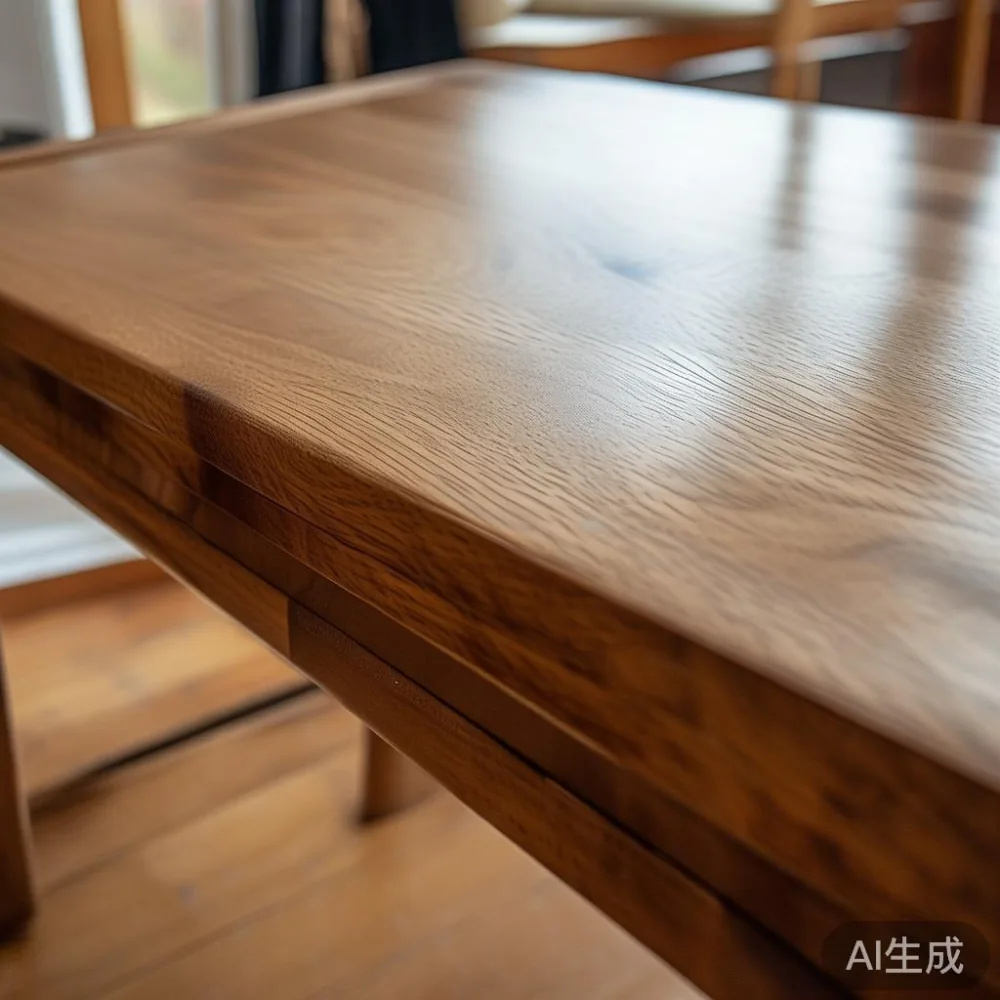
For the first three months, treat every lacquered surface — dining tables, solid wood sofa armrests, wardrobe doors, nightstand tops — with a dry microfibre cloth (around S$12 for a 5-pack) and nothing else. No pledge, no oil, no vinegar-water solutions. The factory finish has already been polished to a 90-gloss sheen; what it needs from you is friction-free contact.
If you are the first-time buyer who entertains often, build a 30-second habit: a quick pass of the dry cloth after breakfast and after dinner. That habit alone removes the fine salt residue that Singapore's coastal air deposits on every horizontal surface, and it is enough to keep a marble table base and a solid wood coffee table looking identical to the showroom piece for the first five years.
What should I do about water rings, sunscreen, and curry spills?
Real life happens. Three stains show up repeatedly on Singapore lacquer: the white ring from a cold mug pulled out of an ice bucket, the dull fingerprint from a child holding a soursop popsicle, and the orange smear from a laksa spoon left on a dining table for twelve seconds. None of these require a re-spray. None of them require a professional.
Here is the actual sequence that works on a piano-lacquered MIDHILL coffee table or any lacquered top:
1. Blot, do not wipe. Use a dry microfibre cloth and press straight down for 10 seconds. Wiping spreads the moisture and pushes it under the lacquer film.
2. If a faint halo remains after 24 hours, place a dry cloth over the spot and press a warm (not hot) iron over it for 6–8 seconds. The gentle heat re-fuses the lacquer.
3. If sunscreen or curry oil has actually etched the film, buff with a non-abrasive cream polish (around S$18 for 300 ml) using a clean cloth in straight lines, never circles.
4. Wipe again with a dry cloth to remove residue.
This sequence works on a lacquered solid wood sofa arm, a lacquered European light luxury dressing table top, and any lacquered headboard. The key is patience: most halos fade on their own within 48 hours if you simply stop touching them.
How does light luxury styling affect how I should care for the piece?
Light luxury — French light luxury, American light luxury, and the post-modern light luxury lines you see across MIDHILL's catalogue — share one feature: high-gloss or satin lacquer over solid wood, often paired with marble, brass, or fluted glass. The aesthetic is glossy. The care routine, however, is the same low-gloss, low-intervention routine you would use on any lacquered surface. A S$3,200 American light luxury sideboard does not need a different cloth than a S$1,400 post-modern nightstand. They both want microfibre, dry hands, and 55% room humidity.
For first-time buyers comparing light luxury sofa vs Nordic sofa care, the difference is real: Nordic oiled oak wants monthly waxing; light luxury lacquer wants monthly nothing. If you are choosing between a light luxury sofa and a Nordic sofa for a HDB living room, factor in this maintenance contrast over the next ten years. The light-luxury piece saves you roughly 120 hours of conditioning time across a decade.
Same logic for the bedroom: if you are browsing a Japandi bed frame with an oil finish, expect a quarterly wax. If you are browsing how to style Japandi sofa in bedroom with a lacquered piece, expect a quarterly wipe. For shoppers comparing for sale Coastal furniture against lacquered coastal-inspired pieces, ask the showroom which finish the surface actually carries — the answer changes your cloth budget for the next decade.
How do I handle the HDB-specific challenges?
Three challenges are specific to Singapore HDB and condo living: lift size, corridor width, and pest pressure.
1. Lifts. Standard HDB passenger lifts are 1.2 m wide × 1.5 m deep × 2.1 m high. A king-size solid wood bed frame from MIDHILL arrives in two cartons, each around 1.95 m × 0.65 m × 0.18 m. Measure first. If your HDB is a 5-room at Punggol with a wider service lift, you can usually fit the dining table unboxed. If you are in a 3-room at Bedok, request flat-pack assembly on-site.
2. Corridors. The corridor outside your HDB unit is typically 1.2–1.5 m wide. When delivery day arrives, the two-man team needs at least 1.4 m of turning radius to bring a wardrobe in flat-pack form. Clear your lobby shoe rack the night before.
3. Pests. Singapore's humidity invites booklice and silverfish, both of which leave tiny black specks on lacquer. Wipe with a dry cloth weekly and vacuum the corners with a soft brush. Do not spray insecticide directly on lacquer — the solvent will cloud the film within minutes.
When is professional refinishing worth it?
MIDHILL offers lifetime refinishing on lacquered solid wood pieces — bed frames, dining tables, wardrobes, nightstands, and the brand's marble table range. For a first-time buyer, the question is when to actually use it. The answer is simple: after year eight, or after the third deep gouge, whichever comes first. A surface scratch from a chair being dragged across a lacquered top is cosmetic — buff it out with the cream polish method above. A gouge that catches your fingernail is structural — book the refinishing service.
For shoppers browsing top 10 Post-modern furniture lists and wondering which lacquered piece will age best, the rule is: the thicker the factory lacquer, the longer the interval. MIDHILL's post-modern light luxury line uses a 7-coat process on dining tables and a 5-coat process on solid wood bed frames. That difference translates to roughly 12 years before refinishing versus 8 years for thinner 3-coat pieces.
Quick checklist for the first-time buyer
Before you check out on a S$2,000+ lacquered piece, run through this list:
- Buy a S$25 hygrometer and a S$12 microfibre cloth pack on the same day.
- Measure your lift (1.2 m × 1.5 m × 2.1 m for most HDBs) and your unit's doorway (typically 0.9 m wide).
- Schedule delivery for a weekday morning so the air-con has been running for at least four hours before the pieces arrive.
- Leave every piece untouched for 14 days.
- After day 14, dry-wipe only. No chemicals.
- Re-evaluate at year 8 for refinishing.
That is the entire routine. A first-time buyer who follows it will see their S$2,480 dining table, S$1,800 bed frame, and S$1,200 nightstand still holding a clean reflection in year ten — and that reflection is the whole point of light luxury lacquer in the first place.