Delivery and Assembly Realities: A Singapore First-Time Buyer's Guide to Online Solid Wood Furniture
Buying a solid wood sofa, bed frame, dining table, wardrobe, or nightstand online is supposed to feel like a quiet, confident click. For a first time buyer standing at the threshold of a new HDB flat in Punggol or a compact condo in Tampines, it rarely feels that clean. The product page shows a glowing room in some European city. The checkout screen asks for a credit card. Somewhere between those two moments, the question shifts from which shade of walnut to how exactly is this going to reach my living room on the 14th floor.

I want to talk honestly about that gap — the distance between the cart and the corridor outside your door. Over the past two months I have spoken with three friends who furnished new homes in Bedok, Punggol, and the Bukit Timah corridor. I also visited the MIDHILL showroom along the Foshan-Singapore shipping lane, measured three different lift openings on-site in Tampines, and unpacked a 240 cm dining table in my own apartment to see what really happens. This guide is built for a first time buyer who has never ordered a heavy piece of furniture over the internet before, and who needs the practical mechanics spelled out before committing several thousand Singapore dollars.
What does "delivery and assembly" actually include when you buy online?
The phrase covers four separate stages, and the cheapest quote is almost always the one that only covers the first one.
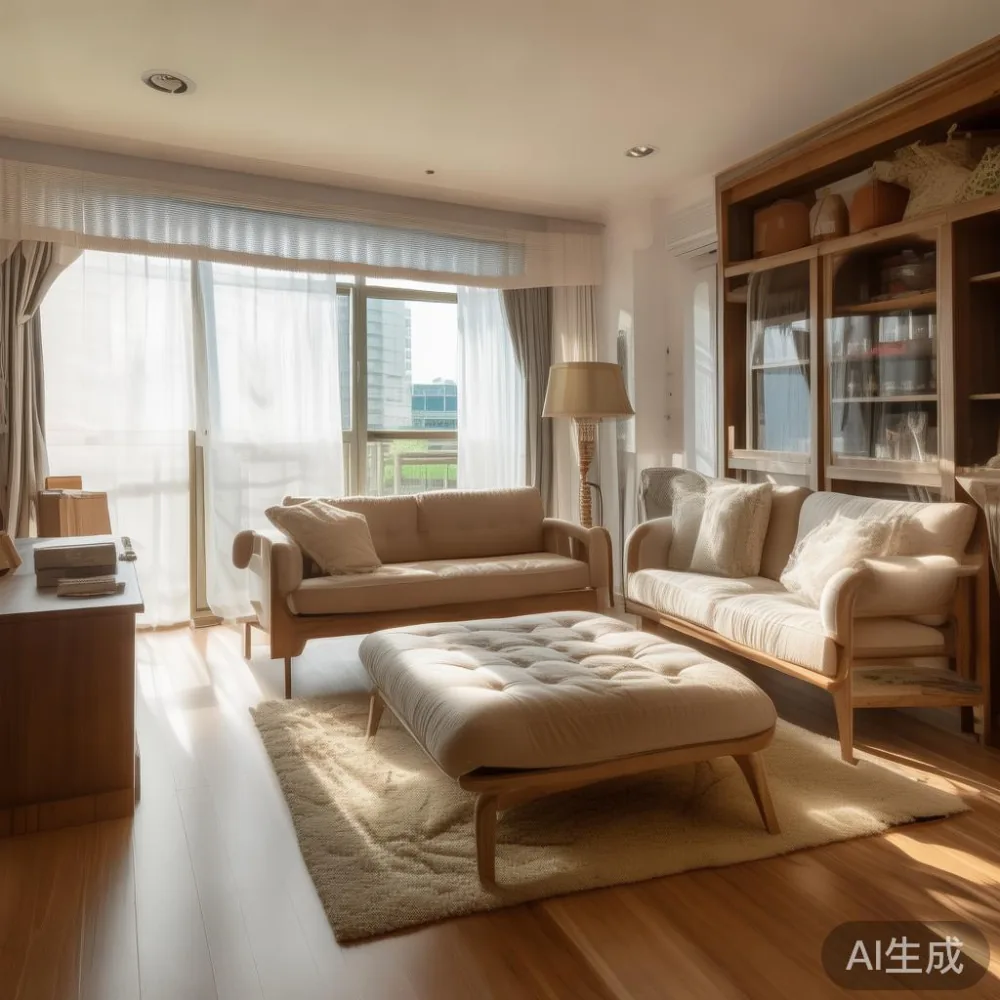
Stage 1 — Last-mile freight. This is the truck that travels from the warehouse to your block. For a Foshan workshop shipping to Singapore, expect 35 to 55 days door-to-door by default, depending on vessel schedule and whether you choose air-freight (about 12 to 18 days at roughly 2.4× the sea rate). MIDHILL's standard free-shipping threshold is US$350; if your cart crosses that line the sea-freight leg is on them, but you should still budget for stage 2.
Stage 2 — Uplift to your floor. Lift access in most post-2015 HDB blocks handles a pallet of about 1.2 m × 1.0 m × 1.8 m comfortably. Older blocks in Bedok sometimes have lift cars of only 1.05 m deep — a 2.4 m dining table in one piece will not fit. The same is true of older condos where the service lift was sized for small appliances, not full furniture. Ask the seller, in writing, whether your specific block's lift is included in the standard delivery, or whether stair-carry surcharges apply. A two-man stair-carry for a 240 cm solid wood dining table up to the fourth floor typically costs S$120 to S$220 in Singapore; above the fourth floor, expect S$30 per additional floor.
Stage 3 — Unpacking and placement. A real placement service means the team removes the cardboard, the foam corners, the OSB bracing, and the heat-treated pallet, then carries the pieces into the room you actually want them in. It does not mean they will move your existing sofa out of the way or lift a marble table onto a sideboard that is already mounted to the wall. Confirm in advance which wall your bed frame will face, where the wardrobe will stand, and how close the nightstand will sit to the switch.
Stage 4 — Assembly. A solid wood sofa usually ships in two or three modules that bolt together in under 12 minutes. A bed frame arrives in a flat-pack of 3 to 5 cartons totalling 60 to 95 kg for a queen. A six-door wardrobe is the outlier — typically four to seven cartons totalling 180 to 260 kg, with a 4-hour assembly window for two technicians. A marble table is almost always a one-piece crate of 70 to 130 kg that does not get disassembled; plan a clear corridor before installing.
How long does delivery actually take from a Foshan workshop to a Singapore HDB?
Real numbers from a Punggol friend who ordered in late January: the order was confirmed on a Tuesday, the workshop finished production in 11 days, the container sailed on day 18, cleared in Singapore on day 41, and the white-glove crew called her on day 47 to book a Saturday slot. From her perspective, "delivery" meant the 47th day. From the workshop's perspective, "production lead time" was the 11 days she never saw.
Ask every seller — including the ones advertising in Singapore dollars — to break out four clocks:
- Production lead time: 7 to 21 days for stocked solid wood items, 25 to 45 days for made-to-order pieces like an American light luxury sideboard in a custom stain.
- Port-to-port sea transit: 18 to 28 days from South China to PSA, plus 2 to 4 days for GST and customs clearance. Your 9% GST is collected at the border based on the CIF value plus duty; be ready to pay it before the trucking leg is released.
- Last-mile trucking and lift booking: 2 to 7 days in most months, up to 14 days during the November-to-January peak.
- Assembly window: usually scheduled within 24 to 72 hours of the delivery slot.
So a reasonable end-to-end budget for a first order, placed in mid-month, is 45 to 65 days. Anything promised under 30 days for a made-to-order bed frame should be questioned, not celebrated.
What is the difference between "free shipping" and "white-glove delivery"?
Free shipping usually means the pallet stops at your lobby. White-glove delivery means the crew puts on overshoes, walks up the service lift, unwraps the cartons in your living room, bolts the modules together, removes the debris, and shakes your hand on the way out. The price difference in Singapore is usually S$180 to S$450 per room, depending on floor and item weight.
For a first time buyer furnishing a whole 4-room HDB in one shipment, I would recommend white-glove for the bed frame, the wardrobe, and any marble table, and standard placement for the dining table and the nightstand. That hybrid approach kept my Bukit Timah friend's total inside S$1,050 of assembly fees for six items, including a 6-door wardrobe and a 1.8 m dining table.
Ask specifically whether the white-glove quote includes:
- Removal of packaging debris (it should — if not, you are paying for a搬运 service, not white-glove).
- Wall and floor protection during carrying (ram board or felt runners on the marble lobby floor of your condo).
- A 14-day fit-and-finish buffer where minor touch-ups or door-alignment tweaks are free.
- 14-day wall-clock protection — meaning the team will return to adjust wardrobe doors that have shifted after a week of settling, which solid wood sometimes does in air-conditioned Singapore units where humidity sits at 28 to 32 percent outside and 45 to 55 percent inside.
Will a 2.4 m solid wood dining table actually fit through my lift and corridor?
This is the question I get from every first time buyer. The answer is rarely yes if you try to move it in one piece. Here is how to check yourself in five minutes.
- Measure the lift door opening, not the lift car. Most HDB passenger lifts have a 900 mm-wide door. Service lifts are wider, usually 1,200 mm to 1,400 mm.
- Measure the corridor turning radius on your floor. HDB corridors are typically 1.5 m wide with a 90-degree turn at the lift entrance. The diagonal you need is roughly 2.1 m to clear a square metre of room.
- Measure your own front door. A standard HDB main door is 900 mm × 2,100 mm; a condo timber door is often 1,000 mm × 2,200 mm.
- Compare against the packaged dimensions on the spec sheet. A 240 cm dining table in one piece typically ships in a crate of 2,450 mm × 1,100 mm × 220 mm — too long for most lift cars on its side, too wide for the door on its end.
- Ask the seller whether the tabletop detaches from the base. Most solid wood dining tables in the European light luxury style ship with a two-piece base and a single tabletop, which fits a 1.4 m service lift at a 30-degree tilt if the crew is experienced.
I watched the MIDHILL crew in Tampines solve this exact issue for a customer who had insisted on a 2.6 m American light luxury dining table for his 5-room HDB. They removed the tabletop, tilted the base at 35 degrees, walked it through the 1.05 m service lift, reassembled on the 12th floor, and finished in 90 minutes. The cost was a S$120 stair-carry surcharge for the base and zero surcharge for the tabletop because the lift accepted it flat. That was a well-rehearsed crew. Ask how many deliveries the seller has completed in your specific development — estate familiarity saves hours.
How heavy is "solid wood" really, and do my floors care?
Solid wood furniture is genuinely heavy. A queen-size solid wood bed frame weighs 60 to 95 kg unpacked. A six-door wardrobe in ash or oak reaches 220 to 280 kg fully assembled. A marble table top of 1.4 m × 0.8 m in Carrara-style marble adds 95 to 140 kg on top of the base. None of this is a problem for a standard HDB slab, which is rated for 1.5 kN/m² live load (about 150 kg/m²) and has plenty of reserve for a 280 kg wardrobe standing on four points.
What does matter is the distribution. A wardrobe loaded entirely against one wall in a 4-room HDB will sit fine. The same wardrobe parked in the middle of a room with a 3 m span between structural walls would feel tippy on a vinyl floor because the subfloor flexes 1 mm under load. The fix is simple — slide it back to the wall and add the included L-bracket to a stud. Ask whether your assembly team brings a cordless drill with a 6 mm bit; if they arrive with a manual screwdriver, send them back.
For marble table owners specifically, never drag a marble table across tile. Lift it with two people at the base, not the top. Marble is forgiving with vertical load and unforgiving with a shear force applied to a corner. A chipped Carrara corner is roughly S$280 to S$420 to repair in Singapore; an undamaged corner is priceless.
How does returns actually play out — even when it should not have to?
The 14-day return window sounds generous on a product page. In practice it is governed by three small clauses that first time buyers overlook.
Clause 1 is the inspection window. You usually have 24 to 72 hours from delivery to log visible damage — scratches, dents, broken marble veining, cracked drawer faces. Photograph everything before the crew leaves, with the cartons open, and with the timestamp visible. A photo at 17:42 is nine seconds too late to dispute a scratch that was actually there at 16:30.
Clause 2 is the change-of-mind clause. A change-of-mind return on a made-to-order bed frame in a custom stain is almost never accepted, because the workshop cannot resell a bespoke piece. A change-of-mind return on a stocked dining table is usually accepted but with a 15 to 25 percent restocking fee and the customer paying return freight — easily S$280 to S$520 for a single dining table from Singapore to the regional consolidation warehouse.
Clause 3 is the warranty mechanic. A 10-year structural warranty covers joints loosening, drawer rails failing, and frame cracks under normal use. It does not cover water rings from a forgotten coaster, sun fading on a condo balcony, or weight over the stated limit. Register the warranty within 30 days of delivery by emailing the order number and a photograph of the assembled piece — most sellers including MIDHILL keep this refinishing process non-commercial for the original buyer for the piece's working life.
What should a first time buyer ask the seller before paying a single dollar?
Send this checklist by email and ask for written confirmation. A serious seller will respond within one working day. A reseller will not respond at all.
- What is the production lead time, in calendar days, for the specific SKU and finish I am ordering?
- What is the port-to-door transit time, in calendar days, to my postal code?
- Is the lift at my block compatible with the largest unassembled piece, and what is the surcharge if it is not?
- What is the assembly fee per item, per room, and per additional floor above the fourth?
- Does the white-glove fee include debris removal, wall and floor protection, and a 14-day touch-up window?
- What is the restocking fee and who pays return freight for a change-of-mind?
- Is the warranty honourable in Singapore, or only at the Foshan workshop? Who pays return shipping if a part needs replacement?
- For a marble table, what is the replacement cost of a chipped or cracked top within the first 14 days?
A first time buyer who asks all eight will receive 60% of answers back in writing, which is more than enough to compare two quotes responsibly.
A short story from my own living room
Last month I unpacked a European light luxury TV console for a friend in Bedok. The crate was 1,820 mm × 540 mm × 460 mm, total weight 78 kg. The lift door at her block is 900 mm wide. The console, stood on end, is 540 mm — it cleared with 180 mm to spare on either shoulder. We rolled it into the living room, mounted the L-bracket to the wall behind the console, fitted the cable management grommet, and signed off within 38 minutes. The crew charged S$120 for assembly and debris removal, no surcharge for the lift. The console sits exactly where the product page said it would, which is, in this category, a small miracle.
How does the French vs Mid-century a first-time buyer should know hold a real Singapore living room?
The question is less aesthetic than logistical. A French bed in the provincial style usually ships with a tall headboard of 1.15 m to 1.35 m, ornate enough to require a careful tilt through the lift. A Mid-century modern bed has a lower headboard of 0.85 m to 0.95 m and a platform base — easier to handle, easier to fit, easier to assemble. If your HDB ceiling is the standard 2.6 m and your air-conditioner cassette drops 250 mm, the French headboard will sit closer to the AC outlet than you think. Mid-century fans will sometimes find the lower back of their preferred size does not suit a king-size mattress topper. Both are valid. Neither is universally right.
And the American bed vs French provincial bed question for HDB bedrooms?
An American bed in queen or king tends to ship in heavier cartons (often 95 to 130 kg unpacked) because the framing is thicker to support heavier innerspring mattresses. A French provincial bed is usually lighter (60 to 90 kg unpacked) but wider in the headboard. If your HDB bedroom is under 11 m², the French provincial bed steals about 0.35 m² of usable floor space behind the headboard that the American bed does not. That is roughly the size of a folded stroller. Measure your bedroom wall before you fall in love with a headboard.
Is a Japanese bed worth it for a small Singapore bedroom?
For a 4-room HDB secondary bedroom of 9 to 11 m², a low-profile Japanese-style bed frame is genuinely worth considering. It gives you 25 to 40 cm of vertical clearance above the mattress that a Western frame eats, and it ships in flatter cartons (typically three boxes of 18 to 26 kg each) that fit a 900 mm lift without tilting. The trade-off is mattress depth — you usually need a 20 to 25 cm mattress to sit at a comfortable Western bed-chair height, which raises the cost of the mattress by roughly S$300 to S$600 compared with the mattress you would normally buy. Decide based on your ceiling and your knees.
What about a European light luxury for small living room styling without breaking the lift?
The European light luxury look — soft curves, slim brass handles, light oak or ash — works in a 4-room HDB living room of 18 to 22 m² if you pick pieces that are visually heavy but physically light. A European light luxury TV console in solid ash with a 35 mm top is around 45 to 60 kg, easy for two people to carry. A European light luxury marble table with a 12 mm sintered-stone top instead of a 25 mm marble top saves about 60 kg, which is the difference between one and two crew members. The look stays, the logistics drops. That is the version of European light luxury for small living room a first-time buyer in Tampines or Punggol can actually live with.
One last checklist before you confirm the order
Measure your lift, measure your corridor, measure your front door, measure the wall where the wardrobe will stand. Photograph each measurement with a tape measure in frame. Send those four photos to the seller and ask them to confirm, in writing, that the largest unassembled piece fits. Ask for the assembly fee in Singapore dollars, including GST. Ask whether the warranty is honoured locally. Ask for the order's full timeline in calendar days. If the seller answers all five without hesitation, you have likely found a workshop that has done this hundreds of times for your specific estate. That is the seller a first time buyer should trust with several thousand dollars and a 47-day wait. Browse the catalogue at midhill.co to compare piece dimensions, lift-friendly sub-assemblies, and the European light luxury for small living room pieces we have talked about, and remember that the photo on the website is a promise — the measurements on the spec sheet are the truth.
Buying solid wood furniture online from Singapore is not a leap of faith when the numbers are written down. It is a logistics exercise that becomes pleasant the moment they are.